It was evident that Donald Trump was likely to lose 20
minutes after polls closed in California.
At 11:20 p.m. EST, the Fox News Decision Desk called Arizona
for Joe Biden. The Copper State had gone Democratic just once since 1948, when Bill Clinton won by two points in his 1996
landslide.
Without Arizona, Trump would have to win three of the five undecided
swing states (Georgia, Nevada, Wisconsin, Michigan, Pennsylvania) to stay in
power. The Blue Wall states (WI,
MI, PA) had supported Democratic candidates in every presidential election but
one since 1992. Nevada had gone Democratic for the last three presidential
cycles.
Sensing that they might have been
dealt a death blow, the Trump campaign had conniption
fits when Arizona was called
by their network of choice. A call was put in to Fox chairman Rupert Murdoch.
Murdoch later “testified that he could hear Trump shouting in the
background as the then-president's son-in-law, Jared Kushner, told him the
situation was ‘terrible.’”
Murdoch reportedly said,
“‘Well, the numbers are the numbers.’”
Two-and-a-half hours later, Biden won Nebraska’s 2nd district,
a right-leaning swing district that had gone Democratic just
one other time.
Arizona and the 2nd
district gave Biden 238 electoral college votes. To get to the magic number of
270, he just needed to win Wisconsin (10 electoral votes), Michigan (16), and
Nevada (6), Georgia (16), or Pennsylvania (20).
With so many routes to 270, Biden’s likelihood
of winning shot up to 80% at electionbettingodds.com by the morning of November
4.
That afternoon-into-evening, pre-2016
patterns reappeared when Wisconsin and Michigan were called
for Biden, the latter by over 150,000 votes.
Trump’s
campaign team made noise about challenging Biden’s 20,000-ballot Wisconsin
victory, but as former Wisconsin governor and Trump ally Scott Walker pointed
out at the time, a recount was highly
unlikely to change the result.
With Wisconsin
and Michigan in Biden’s column, Democrats needed just six more electoral
college votes to retake the White House, exactly the number in Nevada. Biden’s chances of losing Nevada were low, and Pennsylvania appeared
to be a really good bet, based on
Trump’s narrowing margin and the proportion of votes which remained to be
counted in heavily-Democratic precincts.
Joe Biden was officially
declared the winner of
Pennsylvania and president-elect of the United States at 11:26 a.m. EST on
Saturday, November 7, 2020.
Biden went on
to win Nevada and Georgia, giving him 306 electoral college votes—well above
the necessary threshold of 270—to go with a commanding seven million-ballot
popular vote win.
If anything,
it was surprising that the race was close, given that
Biden came into election day with an 8.4% national lead, according
to 538.com.
Among the
possible causes for the polling errors were aggressive GOP voter
suppression in some swing states, the reluctance of some Trump supporters
to talk to pollsters, and Trump’s momentum at the end of the race, which was helped
along by an endless tour of crowded, virus-spreading rallies at the height of
Covid-19 (something the Biden campaign didn’t risk).
Sifting
through the election results, it was apparent that record levels of culture
war polarization enflamed by Donald Trump turned right-leaning, non-degreed whites
out in droves. Iowa and Ohio (which were forecast to be close)
were Republican blowouts, and Biden’s Wisconsin win was narrower than
pollsters thought it would be.
At the same
time, racial divisiveness backfired among many young
voters, suburbanites, and most people of color, driving Georgia and Arizona to
Joe Biden.
Given
voter turnout demographics, the results of the 2020 presidential election were relatively
orderly and predictable. Biden’s victory was more conclusive than Trump’s 2016 victory, either of W. Bush’s wins, and his
popular-vote margin exceeded Obama’s 2012 re-election.
In
a functional democracy, the Pennsylvania call would have triggered a graceful
concession and set the presidential transition in motion.
But
America had the distinction
of being governed by Donald J. Trump, a deeply-wounded narcissist with no
regard for the rule of law.
***
Trump’s
disinformation campaign began long
before the election with constant repetition of the false claim that mail balloting was
inherently corrupt
and that the 2020 election would be “rigged” against him.
Mail balloting
was targeted because Trump knew Democrats would use it in higher proportions
than Republicans, since they were more concerned about getting Covid-19 at crowded polling
stations.
This
false narrative was also a way to pre-emptively delegitimize a potential loss at the
polls. Trump repeated this lie so often that many Republican
voters took it at face value, prepping his followers to believe the blizzard of
lies to come.
There were hints
that Trump might refuse to concede before November 2020.
In July, well
behind Joe Biden in the polls, Trump was rebuffed by his own party when he used
false pretenses to propose that the
presidential election be delayed (which hadn’t even happened during the Civil
War).
In August, it
was reported that Facebook executives
were gaming out post-election scenarios in which Trump refused to admit defeat.
In September,
Trump publicly suggested that the election could be decided by unelected judges on
the federal Supreme Court—rather than the voters—and ordered the extreme right Proud
Boys to “stand back and stand by” in the first presidential debate.
As the
election drew near, Trump failed to close the polling gap with Biden due to
mass job losses and his poor handling of the worsening Covid-19
pandemic.
Outside
of the right-wing echo chamber, it was common knowledge that Republican-leaning,
in-person votes would be counted first in a lot of competitive states, creating
a “red mirage” (the false impression
that Trump was going to win), after which there would be a “blue shift” as more
Democratic votes—mail votes in particular—were counted.
Three
days before the 2020 election, Tom Fitton of the right-wing group Judicial Watch emailed Trump an election night
speech to exploit his base’s programmed ignorance of the red mirage/blue shift:
“The voters have spoken. The ballots
counted by the Election Day deadline show the American people have bestowed on
me the great honor of reelection to President of the United States. Federal law
establishes November 3 as Election Day – the deadline by which voters in states
across the country must choose a president. Some partisans will try to overturn
today’s lawful election results by shamelessly counting ballots that arrive
after Election Day for days and weeks. This is lawless, invites massive voter
fraud, undermines our democracy, and could dishonestly cancel the votes of tens
of millions of Americans who ensured their votes would arrive to be counted on
Election Day. I am prepared to go to court to make sure this election is not
stolen and am directing the Justice Department to defend federal election law
accordingly. We had an election today – and I won. Some believe Election Day
deadlines don’t matter and would attack democracy through fraud and judicial
activism. Counting ballots that arrive after Election Day is unfair and shows
contempt for the will of the people. I will defend, to the full extent of the
law, free and fair elections and our constitutional republic from any electoral
coup. Thank you and God bless America.”
That same day,
Trump strategist Steve Bannon told “a group of associates” about
this plan to stage a big announcement not long after
polls closed, while the red mirage was at its peak:
“What Trump’s gonna do is just declare victory. Right? He’s
gonna declare victory. But that doesn’t mean he’s a winner….He’s just gonna say
he’s a winner.”
Jonathan Swan of Axios broke a
story about this strategy on November 1, two days
before the election. According to Swan, “President Trump has told confidants he'll declare
victory on Tuesday night if it looks like he's ‘ahead,’ according to three
sources familiar with his private comments. That's even if the Electoral
College outcome still hinges on large numbers of uncounted votes in key states
like Pennsylvania.” Swan would later report that this plan had been
in the works since “the second week of October.”
Trump ally
Roger Stone was filmed saying much the same in
conversation with other Trump supporters:
“I really do
suspect it’ll still be up in the air. When that happens, the key thing to do is
to claim victory. Possession is nine tenths of the law. ‘No, we won. Fuck you,
Sorry. Over. We won. You’re wrong. Fuck you.’”
Right on
script, Trump held a press conference at 2:20 a.m.
EST on the morning after election day. He read off his election day numbers in
swing states and claimed that his shrinking leads resulted from duplicity:
“This
is a fraud on the American public. This is an embarrassment to our country. We
were getting ready to win this election. Frankly, we did win this election.”
After
the applause died down, he added, “So our goal now is to ensure the integrity
for the good of this nation.”
***
The unveiling
of The Big Lie was a trumpet call to right-wing
extremists.
The theory was
tailor-made for the big portion of Trump’s base motivated by white grievance
narratives.
Only too happy to exploit this sense of victimhood in the name of raw power were
Trump’s allies in state
legislatures, Congress, the Republican Attorneys
General Association, right-wing television media, and social media.
While gullible and crestfallen
Republican voters were being conned with a bullshit cover story in public, Trump
allies worked behind the scenes to keep Joe Biden out of the White House.
The day after the election, November 4, 2020, the Trump campaign contracted with
Simpatico Software Systems in hopes of finding evidence of voter fraud which
could be used in courtrooms and in the court of public opinion.
The
GOP also sent “protesters” to a
vote-counting center in Detroit—which is 78% Black—to whip up
Republican indignation and
stir public doubt.
While America’s
eyes were distracted by shiny objects, the shadow
campaign to steal the White House kicked into high gear. Central to this
effort was Trump’s chief of staff Mark Meadows, who would
be “directing traffic” among
conspirators (including 34 members of Congress.) That day, Meadows
received a text from Energy
Secretary Rick Perry suggesting an “aggressive strategy” to keep Trump in
office.
The plan was
to convince at least three Republican-controlled legislatures (in swing states
Trump had lost) to shatter long-standing legal precedent by overriding the will
of their voters and declaring electors for Trump.
Shorting Biden
of three of these six swing states—Michigan, Pennsylvania, Nevada, Wisconsin,
Georgia, Arizona—would throw the election to the House of Representatives,
where Republicans had a majority of delegations in more states than Democrats, thanks to gerrymandering.
As
reported at CNN.com,
on November 5 Mark Meadows received a text from Donald Trump, Jr. which
discussed “filing
lawsuits and advocating recounts to prevent certain swing states from
certifying their results, as well as having a handful of Republican state
houses put forward slates of fake ‘Trump electors.’
“If all that failed, according to the Trump, Jr.
text, GOP lawmakers in Congress could simply vote to reinstall Trump as
President on January 6.”
The will of the American people was irrelevant,
according to Trump, Jr.:
“It’s very simple….We have multiple paths. We control
them all.”
Trump ally Roger Stone was in sync with Donald Jr. Dictating
to an aide on camera, Stone said, “Although state officials in all 50 states must ultimately certify the
results of the voting in their state…the final decision as to who the state
legislatures authorize be sent to the Electoral College is a decision made
solely by the legislature….Any legislative body may decide on the basis of
overwhelming evidence of fraud, to send electors to the Electoral College who
accurately reflect the president’s legitimate victory in their state, which was
illegally denied him through fraud.”
Meanwhile, Trump sent a series of tweets encouraging supporters to disrupt vote counts in the
minority-majority swing state cities of Detroit, Philadelphia, and Atlanta.
Meadows
received another
fake electors proposal on November 6 from Andy Biggs, a House representative from Arizona, to
which he texted back, “I love it!”
Also on the 6th,
Representative Paul Gosar of Arizona (who
would later be tied to the January 6 “Save
America” rally) sent out widely-shared tweets implying that his states’ tally was fraudulent due to vote-flipping
on Dominion voting machines.
This would be Trump
supporters’ main voting fraud talking point up through January 6.
While
Republicans publicly implied that fraud had taken place in America’s black and
brown Democratic cities, Trump spokesman Jason Miller texted Mark Meadows
and a host
of other top officials that the narrative was demonstrably false in
Pennsylvania, which was about to be declared for
Biden:
“One other key data
point: In 2016, POTUS received 15.5% of the vote in Philadelphia County. Today
he is currently at 18.3%. So he increased from his performance in 2016. In
2016, Philadelphia County made up 11.3% of the total vote in the state. As it
currently stands, Philadelphia County only makes up 10.2% of the statewide vote
tally. So POTUS performed better in a smaller share. Sen. (Rick) Santorum was
just making this point on CNN - cuts hard against the urban vote stealing
narrative.” (Philadelphia’s Republican city commissioner Al Schmidt would say much
the same thing to CNN a few days later.)
On the day Joe Biden
was declared president-elect, November 7, Trump
met
with conservative activist David Bossie and top campaign staff Bill Stepien,
Jason Miller, and Justin Clark in the White House. Deputy campaign manager
Clark said Trump’s only hope of reversing his loss lay in squeaking out
victories in Georgia and Arizona, which were still counting votes, and getting
thousands of Wisconsin votes disqualified over
technicalities. Clark said this had a “5 to 10
percent chance” of succeeding.
With the chances of legal victory so slim, Trump started
looking for outside-the-box thinking. That day, Utah senator Mike Lee hinted at
what was to come when he texted Mark Meadows with a suggestion that
Trump meet with Republican lawyer Sidney Powell, who “[had] a strategy to keep
things alive and put several states back in play.”
Key to Powell’s strategy would be a sustained PR attack on
Dominion Voting Systems, which were used in multiple swing states. By claiming
that Dominion had rigged those states for Biden, Trump’s people would imply
that state legislatures should be allowed to override “fraudulent” official
vote counts.
Fox executives considered the theories so outlandish that
they cancelled
that night’s Jeanine Pirro’s show (in which she planned to target Dominion).
But the caution would be short-lived.
The following day, November 8, Fox chairman Rupert
Murdoch texted
Fox CEO Suzanne Scott that his network was “Getting creamed by CNN!” Apparently,
many of his partisan viewers didn’t have the heart to watch infotainment about
a one-term president who had lost his re-election battle.
That day, Fox attempted to juice
their ratings by having Sidney Powell on the Maria
Bartiromo show, the
first of several appearances Powell, Giuliani, and other conspiracy-peddling
Trump allies would make on the network.
On November
9, Trump’s exceptionally loyal attorney
general, William Barr, sent a directive to federal prosecutors to ramp up voter
fraud charges before state elections were certified, a change in Justice
Department policy which prompted the resignation of Richard
Pilger, who headed the department’s election crimes division.
In addition, Trump
fired Defense Secretary Mark Esper for not being “sufficiently loyal.” Esper had
fallen out of favor for refusing to deploy
troops to American cities during the summer protests, supporting diversity,
barring Confederate flags on military bases, and keeping an eye on Russia. He
was replaced with the underqualified Christopher
Miller, who brought three Trump loyalists with him, including
Kash Patel, a lawyer
with no military experience.
This
was an oddly
consequential move for an outgoing administration to
make. Suspicions were further aroused when two administration officials told reporters
from the New York Times that Trump was considering firing FBI chief
Christopher Wray and CIA head Gina Haspel. Haspel reportedly told General Mark
Milley (chairman of the Joint Chiefs of Staff), “We are on the way to a
right-wing coup.”
Haspel
was on to something. On November 10, two Texas businessmen linked to
Energy Secretary Rick Perry met with Donald Trump in the Oval Office, where they discussed
the plan to have Republican-controlled swing state legislatures ignore the will
of their voters and unilaterally pick the electors
for their states.
According to I Alone
Can Fix It by Washington Post reporters Carol Leonnig and Phillip
Rucker, when hearing of the fake elector plans circulating, Mark Milley responded
that, “They may try, but they’re not going to fucking succeed” because “You
can’t do this without the military. You can’t do this without the CIA and the
FBI. We’re the guys with the guns.”
Speaking
at a military installation in Virginia on November 11 (Veteran’s Day), Milley
told the assembled crowd, “We
do not take an oath to a king or queen, or tyrant or dictator, we do not take
an oath to an individual….We take an oath to the Constitution, and every
soldier that is represented in this museum—every sailor, airman, marine,
coastguard—each of us protects and defends that document, regardless of
personal price.”
Over at Fox,
panic continued about ratings. Senior VP Raj Shah, who on other occasions had referred
to Sidney Powell’s election claims as “MIND NUMBINGLY NUTS” and “totally
insane,” said the network was “under
heavy fire from our customer base.” Shah suggested they get feedback from
viewers to see “if they have been somehow betrayed by the network” and
concluded that “bold, clear and decisive
action is needed for us to begin to regain the trust that we’re losing with our
core audience.”
Attempts to
regain the core audience’s trust were undermined by Fox reporter Jacqui
Heinrich, who fact-checked a Trump tweet
referencing Dominion lies told on Lou Dobbs’ and Sean Hannity’s shows.
A November
12 group text among Fox stars Sean
Hannity, Laura Ingraham, and Tucker Carlson revealed that Hannity had
complained about Heinrich’s fact-check to CEO Suzanne Scott, who had kicked the
complaint up to Jay Wallace and Irena Briganti, Fox’s head of PR.
In the text, Carlson wrote, “Please get her fired. Seriously…what
the fuck? I'm actually shocked...It needs to stop immediately, like tonight.
It's measurably hurting the company. The stock price is down. Not a joke.”
In a separate text that day, Hannity told Fox
producers “we need to own the dominion story.”
While anchors worried about ratings,
Tommy Firth—one of the producers of Laura Ingraham’s
show—bemoaned the network’s embrace of the Dominion narrative. In a text to Ron Mitchell (a Fox executive involved in the show), Firth said, “This dominion shit is
going to give me a fucking aneurysm—as many times as I’ve told Laura it’s bs,
she sees shit posters and Trump tweeting about it…”
Mitchell
replied that “This is the Bill Gates/microchip angle to voter fraud.”
Experts
agreed. A statement from the Cybersecurity
and Infrastructure Security Agency (an arm of the Department of Homeland
Security created under Trump which closely monitors
elections) said that “The November 3rd election was the most secure in American history.” The
statement went on to say that “There is no evidence that any voting system
deleted or lost votes, changed votes, or was in any way compromised.”
Trump ally
Senator Lindsey Graham actively sought to delete votes on November 13.
While Georgia
was engaged in a recount that Donald Trump was almost certain to lose, Graham called Republican Secretary of
State Brad Raffensperger. According to Raffensperger, Graham asked pointed
questions about signature matching for votes cast. Raffensberger told CNN “Well, it’s just
an implication that look hard and see how many ballots you could throw out.”
Later, when appearing before the
bipartisan House Select Committee to Investigate the January 6th
Attack on the United States Capitol (hereafter referred to as the ‘January 6 House Select Committee’), Raffensperger said “My concern
was, would you be disenfranchising voters when the ballots have already been
accepted by the county process.”
The ballots had been accepted
because they were valid.
As Fox Information Specialist Leonard Balducci emailed producers that day, “There’s no
evidence of widespread fraud in the 2020 election, or of major problems with
Dominion’s systems. Election officials from both political parties have stated
publicly that the election went well and international observers confirmed
there were no serious irregularities.”
Nonetheless, eager to appease the
outgoing president, White House deputy director of communications Zach Parkinson asked Trump staff to look into
conspiracy theories about Dominion voting machines.
Staff gave
Parkinson a memo on November 14 which
showed that many of the claims were false, including the claim—made that night
by Sidney Powell on Jeannine Pirro’s Fox show—that “It is one huge, huge criminal conspiracy that should be investigated by
military intelligence.”
Fox maintained
a focus on ratings. On November 16, Rupert Murdoch told CEO Suzanne
Scott via email that they needed to keep an eye on Newsmax, who was getting a surge of far-right viewers due
to its willingness to hype phantasmal voter fraud (Fox president Jay Fox had called Newsmax’ coverage “an
alternative universe”). Murdoch’s email said, “These people should be watched, if skeptically….We don’t
want to antagonize Trump further, but Giuliani taken with a large grain of
salt. Everything at stake here.”
A November
17 text (which Fox would later
try to have redacted from a defamation trial) revealed Tucker Carlson’s true
feelings about the Dominion story. Of Sidney Powell, he said, “She’s a
psychopath. She’s getting Trump all spun up and has zero evidence.” He added,
“Same with Rudy [Giuliani]. [National Security Council] Cyber did a through
[sic] analysis. There’s nothing to see.”
Though Carlson
considered Powell a psychopath, Arizona GOP chair Kelli Ward recommended her services to Clint
Hickman, forwarding Powell’s number and asking that he “call her.” Hickman, a
Republican who had supported Trump, was chairman of the Maricopa County Board,
which was still counting votes.
Around the
same time, Trump called two Republicans on the
Wayne County Board of Canvassers (covering Detroit,
which is 78% Black) and pressured them not
to certify the results because “We've got to fight for our country….We can't let these people
take our country away from us.” On the call with Trump was GOP national
chairwoman Ronna McDaniel. McDaniel told the canvassers, “If you can go home
tonight, do not sign [the certification]….We will get you attorneys.”
The two
election officials’ efforts to placate Trump came too late to be legally
binding and only delayed the obvious, given Biden’s 154,000-vote margin of
victory in Michigan.
Though Joe
Biden had been officially declared president-elect and was presumably going to
take office, the Trump administration made another significant personnel move
on November 18.
Republican
Chris Krebs, the Trump-appointed head of the Cybersecurity and Infrastructure Security Agency, was fired by tweet
because he had publicly fact-checked election fraud claims and gotten off-message with the
statement that 2020 was “the most secure election in American history.”
Rupert
Murdoch’s Wall Street Journal echoed Krebs’ findings, saying
there was no substance to the Dominion claims, as did Fox host Laura
Ingraham—in private. In a text to Tucker Carlson, Ingraham wrote that “Sidney
[Powell] is a complete nut. No one will work with her. Ditto with Rudy.”
But The Big
Lie was all Trump had left, so the deception continued.
That day, Republicans
Jim Jordan and James Comer made a Twitter announcement
that they would “investigate” the 2020
election to
keep the Republican base on boil while GOP lawyers got to work.
Enter Kenneth
Chesebro.
Chesebro, a
former Democrat and future felon, sent Jim Troupis
(a Republican lawyer in Wisconsin) a memo detailing a
plan to get Wisconsin’s legitimate pro-Biden electors replaced with fake
(pro-Trump) electors. This would be “among the
earliest known efforts to put on paper proposals for preparing alternate
electors” and one of several such memos
Chesebro would
send to GOP operatives in swing states Trump had lost.
According to reporters for the New
York Times, “The memos show how just over two weeks after Election Day, Mr. Trump’s
campaign was seeking to buy itself more time to undo the results. At the heart
of the strategy was the idea that their real deadline was not Dec. 14, when
official electors would be chosen to reflect the outcome in each state, but
Jan. 6, when Congress would meet to certify the results.”
On November
19, Trump’s outside attorneys Rudy Giuliani, Sydney Powell, and Jenna Ellis
had a surreal hair dye-dripping press
conference in which they served up several false claims to try to
pressure the Justice Department to open “a full-scale criminal investigation”
of the election.
These
lawyers were part of “Team Kraken,” second-string attorneys who stepped up to push
claims Trump’s official White House lawyers wouldn’t touch. One GOP operative told a reporter
for New York magazine, “Any time Rudy Giuliani, Sidney Powell, and Jenna
Ellis are leading your legal battle, you are not in a good place….I wouldn’t let those
lawyers represent me for a parking ticket.”
Two members of
Congress in regular text contact with Mark Meadows—senator
Mike Lee of Utah and representative Chip Roy of Texas—were critical of the
press conference. Roy told Meadows, “Hey brother—we need substance or people
are going to break.” Lee said, “The potential defamation liability for the president
is significant here….Unless Powell can back up everything she said, which I
kind of doubt she can.” Meadows wrote Lee back that he agreed and was “very
concerned” about the press conference.
Privately, Fox
chairman Rupert Murdoch referred to the press conference as
"Really crazy stuff. And damaging."
But Fox CEO
Suzanne Scott threw a fit when Fox News White House correspondent Kristin
Fisher fact-checked claims made at the presser. In an email to Fox president Jay
Wallace, Scott said that “I can’t
keep defending these reporters who don’t understand our viewers and how to
handle stories….We need to manage this […] The audience feels like we crapped
on [them] and we have damaged their trust and belief in us.”
On November
20, Trump continued the campaign to flip states
he’d lost when he invited Republican
representatives from Michigan’s state legislature to the White House.
At one point, Trump “raised his false claim, among others, of an
illegitimate vote dump in Detroit. In response, the Michigan Senate Majority
Leader [Mike Shirkey] told [Trump] that he had lost Michigan not because of
fraud, but because the Defendant had underperformed with certain voter
populations in the state.”
After the
meeting, the Michigan representatives made a joint statement to the press in
which they said, “We have not yet
been made aware of any information that would change the outcome of the
election in Michigan and as legislative leaders, we will follow the law and
follow the normal process regarding Michigan's electors, just as we have said
throughout this election.”
Trump was at it again on November
21, tweeting “Why is Joe Biden
so quickly forming a Cabinet when my investigators have found hundreds of
thousands of fraudulent votes, enough to ‘flip’ at least four States, which in
turn is more than enough to win the Election? Hopefully the Courts and/or
Legislatures will have....the COURAGE to
do what has to be done to maintain the integrity of our Elections, and the
United States of America itself. THE WORLD IS WATCHING!!!”
While publicly showing sympathy for
Trump’s outrage, Tucker Carlson texted Trump Kraken attorney Jenna Ellis that “Circumstantial [evidence] won’t
work with this story. If there’s any Dominion documents or copies of the
software show them to me. And as you know there isn’t.”
On November 22, Trump and Rudy Giuliani called Rusty Bowers, the conservative Republican speaker of the Arizona house
who had endorsed Trump. Bowers was asked to have show trials
positing that fraudulent votes among the deceased and
undocumented immigrants may have been the difference in Biden’s Arizona win. He
refused.
On November 23, Trump appointee Emily Murphy of the
General Services Administration finally released money for the Biden Administration’s transition. This unprecedented
delay jeopardized national security (since Biden was not yet receiving
intelligence briefings) and the containment of Covid-19, which was at peak
numbers due to Trump’s failure to address the pandemic.
The president had more pressing
matters than working with public health officials to counteract a virus that
was killing 1,500 of his constituents/day. On November 25, Trump conferenced in from the
White House to a hearing/publicity stunt in Gettysburg, where Trump’s lawyer
Rudy Giuliani issued—and Trump backed—false claims about voter fraud in that
state.
Trump
later invited Pennsylvania
legislators to the White House. Joining Trump was Phil Waldron, a retired Army colonel who would circulate a PowerPoint presentation chockfull
of outlandish conspiracy theories to Republican members of Congress and Mark
Meadows.
False claims
continued on November 29, when Trump spewed election lies and whined
about the FBI and the Justice Department in an interview with Fox News’ Maria
Bartiromo, who would later be sued for
promulgating disinformation about the presidential election.
On November
30, Arizona was certified for Joe Biden. While publicly signing the
paperwork, Republican governor/Trump supporter Doug Ducey silenced a phone call
from the White House.
Ducey
later called Trump back and was subjected to conspiracies about dead and
undocumented voters. According to reporters for the
Washington Post, following this call, “Trump directed Pence, a former governor who had
known Ducey for years, to frequently check in with the governor for any
progress on uncovering claims of voting improprieties, according to two people
with knowledge of the effort.
“In each of the
calls, Ducey reiterated that officials in the state had searched for alleged
widespread illegal activity and followed up on every lead but had not discovered
anything that would have changed the outcome of the election results, according
to Ducey’s recounting to the donor.”
Lack of
evidence to the contrary, Fox continued to nurse their viewership’s grievances.
That day, Sean Hannity hosted Sidney
Powell, whom he had previously
referred to as an “f’ing lunatic.”
Up-’til-then Trump toady William Barr felt the
same way about Powell’s claims. Shockingly, he said so publicly.
On December 1, Barr told the AP, “we have not seen fraud on a scale that could have
effected a different outcome of the election.” According to reporter Jonathan
Karl, Barr felt that Trump’s fraud allegations were “all bullshit,” but he’d agreed to the investigations to “appease his boss.”
In a fit of rage at the breaking AP story, Trump allegedly heaved a porcelain plate of food through the air, leaving servants (and Mark
Meadows aide Cassidy Hutchinson) to wipe up the ketchup which dripped down a wall
of the White House dining room.
Another Republican who refused to
parrot Trump’s
Big Lie was Gabriel Sterling.
Sterling, who worked for Georgia’s conservative
Republican secretary of state Brad Raffensperger, held a
press conference to denounce the violent threats Georgia elections officials were receiving as a
result of Trump’s endless disinformation about voting machines in the state:
“Mr. President, it looks like you likely lost the state of
Georgia….Stop inspiring people to commit potential acts of violence. Someone is
going to get hurt, someone is going to get shot, someone is going to get killed.
And it’s not right.”
On December 2, Fox CEO Suzanne Scott emailed Meade Cooper (Executive VP of Primetime Programming) that fact checks
of Trump’s false claims “[Have] to Stop Now. The Audience is Furious.”
Trump continued to pour gasoline on
the fire. In a speech that day, he said that “In one Michigan county, as an example, that used Dominion
systems, they found that nearly 6,000 votes had been wrongly switched from
Trump to Biden, and this is just the tip of the iceberg.” The claim was false and even if true wouldn’t have mattered, since Trump
had lost Michigan by 154,000 votes.
Trump sent Rudy Giuliani on the road
December 3. In Georgia, Giuliani made “fantastical
claims” for seven hours before
the Republican-controlled Senate Judiciary Subcommittee. Giuliani also took
the carnival to Michigan,
where he refused to be sworn in.
That
same day, Trump’s communication director Alyssa Farah Griffin
went to see Mark Meadows. According
to Griffin, “I'd gone into his office to say that I
was going to resign. I didn't agree with what we were saying about the election
result of the election being stolen. And he said, ‘Wait, what if I can tell you
that we're not leaving office?’”
Key to Trump staying in office was Republican lawyer John
Eastman.
Eastman, working in concert with Kenneth
Chesebro, was one of the central architects of Trump’s extralegal efforts to
overcome democracy. On December 4, he emailed Russ Diamond, a far-right member of Pennsylvania’s House of
Representatives. Eastman proposed that Pennsylvania Republicans challenge and
disqualify enough absentee ballots in the state to “provide some cover” for the
GOP-controlled legislature to declare the election invalid and appoint fake electors
for Trump.
Pennsylvania Republicans didn’t go this far, but they did sign a public letter asking Congress to block their state’s electoral votes
on January 6—“just hours after” PA Majority Leader Kerry Benninghoff and
House Speaker Bryan Cutler “had
unequivocally stated — in a memo cosigned by Senate Majority Leader Kim Ward
(R., Westmoreland) and President Pro Tempore Jake Corman (R., Centre) — that
state legislators had no authority to ignore certified election results and
appoint Pennsylvania’s delegates to the Electoral College themselves, despite
repeated calls from the president and some within their own party to do so.”
The fake elector strategy continued
on December 5, as Trump tried to muscle
Republican governor Brian Kemp into throwing out Georgia’s electors. Kemp, a self-proclaimed “politically-incorrect
conservative” (who had endorsed Trump) refused.
Convincing
Republicans in at least three swing states to reject Biden’s legitimate
electors was still Trump’s only chance at holding onto the White House, barring
a Supreme Court decision to toss out Biden’s wins in several swing states.
To this end, on
December 6, Kenneth Chesebro sent a memo suggesting a “bold, controversial
strategy”
to have fake electors vote on December 14—the day the electoral college would
meet—in the six key swing states. This move would give Mike Pence an
“alternative” (fake/pro-Trump) set of electors to choose from on January 6, the
day electoral college votes would officially be counted in Congress.
Jim Troupis (see
November 18) explained the logistics in a December 7
communication to Trump advisor Boris Epshteyn:
“The second slate [of fake electors] just shows up at noon on
Monday [December 14] and votes and then transmits the results….It is up to
Pence on Jan 6 to open them. Our strategy, which we believe is replicable in
all 6 contested states, is for the electors to meet and vote so that an interim
decision by a Court to certify Trump the winner can be executed on by the Court
ordering the Governor to issue whatever is required to name the electors. The
key nationally would be for all six states to do it so the election remains in
doubt until January.”
One of those
six states was Pennsylvania. Trump’s maneuvering to overcome an 81,000-vote
loss in that state was set back on December 8, when the U.S. Supreme
Court rejected a lawsuit claiming a measure
to expand mail voting (passed by Pennsylvania’s Republican legislature)
had been unconstitutional.
In an email
that day, Trump advisor Jason Miller explained why they kept losing in
court: “When our research and campaign legal team
can’t back up any of the claims made by our Elite Strike Force Legal Team, you
can see why we’re 0-32 on our case.
I’ll obviously hustle to help on all fronts, but it’s tough to own any of this
when it’s all just conspiracy shit beamed down from the mothership.”
Legal setbacks
notwithstanding, the plot continued. Arizona lawyer Jack Wilenchik emailed Trump
advisor Boris Epshteyn
about the means by which fraudulent electors could be used on January 6: “We would just be
sending in ‘fake’ electoral votes to [Mike] Pence so that ‘someone’ in Congress
can make an objection when they start counting votes, and start arguing that
the ‘fake’ votes should be counted.”
Wilenchik further wrote that the
plan should be “[kept] under wraps until Congress counts the vote Jan. 6th
(so we can try to ‘surprise’ the Dems and media with it).” (Wilenchik, who
admitted in the same email that “the votes aren’t legal under federal law,” later
corrected himself, typing in the same thread that
“‘alternative’ votes is probably a better term than ‘fake’ votes,” to which he
attached a smiley face emoji.)
These efforts were coordinated
through outside lawyer Rudy Giuliani, the head of “Team Kraken”; Trump’s
official White House lawyers saw the moves as illegal.
By
the end of December 9, the District of Columbia and all 50 states had certified their vote
totals, and Joe Biden’s win.
Republican
representative (and future House speaker) Mike Johnson of Louisiana sent a
solicitation email to fellow Republicans asking them to join a legal brief
filed by the attorney general of Texas. The aim of the lawsuit was to invalidate
votes in states won by Biden.
While
Republicans tried to invalidate legitimate electors, Kenneth Chesebro emailed Jim Troupis
about how to “operationalize” the casting of fake electors in the six swing states, based
on state-by-state election regulations.
Two days
later, the outgoing Trump Administration considered another major 11th-hour
personnel change.
On December 11. Trump planned to fire CIA
director Gina Haspel’s deputy director and replace him with the woefully-underqualified
Kash Patel (see November 9) in order to install a loyalist near the top of the CIA. As
with the post-election firing of Defense
Secretary Mike Esper and (Cybersecurity and Infrastructure
Security Agency leader) Christopher Krebs, this would be a consequential move for
a lame duck administration to make.
In response, Haspel
told Trump she would resign if her deputy was let go.
Afterward,
Trump met with Mike Pence and other senior aides, who recommended keeping
Haspel happy. Trump left Haspel’s deputy in place.
***
With the
December 14 deadline approaching, fake elector and Nevada State Republican National Committee member Jim DeGraffenreid emailed Kenneth Chesebro with the subject “URGENT-Trump-Pence campaign
asked me to contact you to coordinate Dec. 14 voting by Nevada electors.”
Planning to use an alternate slate of electors in Nevada had
begun as early as four days before the 2020 election, when DeGraffenreid told other state party officials in a text that Nevada’s Republican
Secretary of State Barbara Cegavske “might do a lot of things, but sending a
slate of Republican electors without them being clearly the winners of the
popular vote is not one of them.”
The fake
elector scheme took a hit that day when the U.S.
Supreme Court tossed a lawsuit by
the state of Texas challenging results in four other states, saying
Texas did not
have “a judicially
cognizable interest in the manner in which another state conducts its
elections.”
Outraged by the decision, Trump
supporters held protests across the country on December 12.
The D.C.
rally, which featured future January 6 paramilitary
operators the Proud Boys, the Oath Keepers, and the 1st
Amendment Praetorian, turned violent when counter-protesters showed
up, leading to four stabbings and 33 arrests.
One protester told a reporter for the New York Times, “They
don’t want to deal with this…It’s going to have to go nuclear, using the
Insurrection Act and bringing out the military.” This comment referenced the
possibility that Donald Trump would use the chaos of street violence (even
street violence provoked by his own supporters) as a false pretext to declare a
national emergency, deploy troops domestically, and extend his stay in the
White House.
Concerns about the legality of the
fake elector strategy lingered. Christina
Bobb (an anchor for the far-right One America News) that day sent an email
about Douglas Mastriano, Trump’s point person for Pennsylvania’s fake electors:
“Mastriano
needs a call from [Rudy Giuliani]. This needs to be done. Talk to him about
legalities of what they are doing,….Electors want to be reassured that the
process is * legal * essential for greater strategy.” [emphasis mine]
On the call,
Giuliani claimed that Pennsylvania
Republicans, who would be meeting in two days to pledge their fraudulent
electoral votes for Trump, were meeting on a contingency basis only. Their fake
elector certificates included verbiage to the effect that the certificates
would be valid only if lawsuits went Trump’s way; the certificates were not
intended as absolute substitutes for the legitimate PA electors.
The
conditional language to limit legal liability was used in only one of the six
main swing states; all other fake certificates were
posed as genuine. Kenneth Chesebro suggested to Trump campaign
staffer Michael Roman that the conditional language be used for all of the
certificates, but Roman texted back “Fuck these guys.”
On December 13, Kenneth Chesebro emailed Giuliani about the campaign’s “President
of the Senate” strategy.
The idea was to have Republican
allies in Congress hold hearings questioning the Electoral Count Act precedent,
under which the vice president’s role was purely ceremonial. The hope was that
the hearings could convince Mike Pence to “firmly take the position that he,
and he alone, is charged with the constitutional responsibility not just to
open the votes, but to count them — including making judgments about what to do
if there are conflicting votes.”
Alternately, the hearings could jog
Pence’s doubt about his involvement in counting the electoral college votes. If
Pence recused himself, Trump
ally Charles Grassley would preside over the
process, giving him the option to reject legitimate electoral
certificates and accept fraudulent ones.
One leg of this strategy involved flipping
Georgia, where Trump operative Robert Sinners instructed state Republicans to appoint alternate electors in
“complete secrecy” so that the media wouldn’t know what they were doing:
“I must ask
for your complete discretion in this process….Your duties are imperative to
ensure the end result – a win in Georgia for President Trump – but will be
hampered unless we have complete secrecy and discretion.”
Emails from
Christina Bobb to Trump lawyers and swing state operatives revealed that
state Republicans also had false electors ready in Arizona, Michigan, Nevada, Wisconsin,
and Pennsylvania.
On the final day
before certification, the Trump team added fake electors in New Mexico, which
Biden had won by
double digits. To give this tactic a patina of legitimacy, they filed a lawsuit
challenging Biden’s win six minutes before the filing deadline was up.
In a group
chat that day, Trump
campaign officials—who wouldn’t back the plan in a signed statement—referred to
it as “a crazy play” that would be “certifying illegal votes.”
On December 14, the Electoral
College met and certified Joe Biden’s victory.
According
to Biden, seven Republican senators called to congratulate him. Trump allies
Mitch McConnell, Benjamin Netanyahu, and Vladimir Putin publicly congratulated the
president-elect.
In Michigan, Republican state Senate leader Mike
Shirkey and House Speaker Lee Chatfield announced that they would not get in the way of their voters.
Shirkey said, “[W]e have not received evidence of
fraud on a scale that would change the outcome of the election in Michigan.”
Chatfield said, “We’ve diligently examined these reports of fraud
to the best of our ability. I fought hard for President Trump. Nobody wanted
him to win more than me. I think he’s done an incredible job….But I love our
republic, too. I can’t fathom risking our norms, traditions and institutions to
pass a resolution retroactively changing the electors for Trump, simply because
some think there may have been enough widespread fraud to give him the win.
That’s unprecedented for good reason.
“And that’s why there is not enough support in the House to cast a
new slate of electors. I fear we’d lose our country forever. This truly would
bring mutually assured destruction for every future election in regards to the
Electoral College. And I can’t stand for that. I won’t.”
While Shirkey, Chatfield, and the civilized world recognized
Biden’s victory, 84 state-level Republican officials in seven states (including Michigan) signed
fake elector certificates in
hopes that Vice President Mike Pence would reject the legitimate electors on
January 6.
With the fake electors secured, Trump’s
focus returned to pursuing thus-far elusive evidence of voter fraud.
As reported by CNN, “Trump's
assistant sent [deputy attorney general Jeff] Rosen and [Justice Department official]
Richard Donoghue a document claiming to show voter fraud in Antrim County,
Michigan. An aide to Donoghue forwarded the document to the US Attorneys for
the Eastern and Western Districts in Michigan. Less than an hour later, Trump
tweeted that [Attorney General William] Barr would be leaving the Justice Department
just before Christmas, elevating both Rosen and Donoghue to the top spots at [the
Justice Department].”
***
The day after the electoral
college certified Joe Biden’s win, December 15, Republican Senate Majority Leader Mitch McConnell spoke
publicly on the Senate floor, congratulating Biden
and referring to him as the “president-elect.”
This was significant because McConnell—who had voted with
Trump 91% of
the time and shepherded
his judges through the Senate—was publicly signaling
that he thought Trump’s election challenges no longer had merit.
Rebecca Green of William and Mary Law School told USA
Today, “The legal avenues for
pursuing a change in the outcome of the 2020 election have closed….It's not for
lack of trying. There's just a lack of evidence of irregularities in this
election.”
McConnell had moved on, but Donald
Trump hadn’t.
After McConnell’s speech, Trump
tweeted, “This Fake Election can no longer stand” and invited Jeff Rosen to the
White House. At the Oval Office, Trump pressured his next attorney
general to put Justice Department backing behind election lawsuits, 61 of
62 of which would be rejected by Democratic and Republican judges—including
Trump appointees—often with uncharacteristically
scathing judicial rulings.
On December 16, Senator Mike Lee told
Mark Meadows, via text, that weeks of failures to turn up concrete evidence of
fraud was weakening party resolve. Referring to senators objecting to the
electoral vote certification, Lee said, “I think we’re now passed [sic] the point where
we can expect anyone will do it without some direction and a strong evidentiary
argument.”
Trump’s former
chief of staff Reince Priebus agreed. In a meeting with Trump at the Oval
Office that day, Priebus planned to let Trump down easy, to make it clear that he’d
fought the good fight but it was time to prepare to leave the White House. In attendance were Priebus, Jim
Troupis, Kenneth Chesebro, Mark Meadows, and lawyers who had worked on the
Wisconsin state Supreme Court case Trump had recently lost.
To Priebus’
dismay, Chesebro went off script, mentioning that Trump could still win with
fake electors. The key date was no longer December 14, when the electoral
college had elected Joe Biden, but January 6, when Congress would certify the
electoral college certificates.
Bulling ahead,
someone in the Trump orbit drew up a draft
executive order to have the military seize
voting machines in Georgia. According
to Betsy Woodruff Swan
of Politico, “The order empowers the defense secretary to
‘seize, collect, retain and analyze all machines, equipment, electronically
stored information, and material records required for retention under’ a U.S.
law that relates to preservation of election records.” The order also “would
have given the defense secretary 60 days to write an assessment of the 2020
election. That suggests it could have been a gambit to keep Trump in power
until at least mid-February of 2021.”
Variations on this plan included Rudy Giuliani asking the Department of Homeland Security to seize
machines, Trump asking his attorney general, and Trump asking Republican
legislators in Pennsylvania and Michigan to summon local law enforcement. Memos
were drawn up for both the Department of Homeland Security and the Pentagon to seize voting
machines. The requests were not acted on.
A document
covering similar ground (dated December 17) was referenced in a privilege log
provided
to the
January 6 House Select Committee by the attorney for Bernard Kerik (see
January 4). The withheld document was titled, “DRAFT LETTER FROM POTUS TO SEIZE
EVIDENCE IN THE INTEREST OF NATIONAL SECURITY FOR THE 2020 ELECTIONS.”
On December
18, a memo emerged which advocated for
the Department of Defense (DOD) to appoint a team who would review data (collected
by the National Security Agency) in search of foreign interference in the 2020
election. The memo concluded that the Trump
Administration could take the law into their own hands, depending on the
findings:
“If evidence of foreign interference is found, the team would
generate a classified DOD legal finding to support next steps to defend the
Constitution in a manner superior to current civilian-only judicial remedies (which should still be pursued
in parallel).”
The content of the December 16-18 documents
happened to dovetail with a contentious six-hour meeting at the White House that
evening.
The meeting began when Trump
received “Team
Kraken” (Rudy Giuliani,
Sidney Powell, Michael Flynn, and Overstock.com CEO Patrick Byrne), outsiders
unaffiliated with Trump’s official White House legal team who were happy to entertain—and
act on—the president’s conspiracy theories.
Upon finding out who was with the president,
Trump’s lawyer Pat Cipollone “rushed” to the White House, purportedly out of fear
that Trump might receive advice which could put him at risk of breaking the
law.
According
to witness testimony before the January 6 House Select Committee, a screaming match ensued
between those who supported the rule of law and those who did not.
In the latter category were Rudy
Giuliani and Trump’s former national security advisor, convicted felon Michael
Flynn, who had recently said that Trump should
declare martial law, seize voting machines, and force a new election.
On
the side of historical precedent and the rule of law were White House staff
secretary Derek Lyons and White House lawyers Pat Cipollone and Eric Herschmann.
Among
the ideas Cipollone and Herschmann heard
were Flynn’s claim that foreign countries had rigged America’s election with Nest-brand thermostats
and suggestions that Trump declare
a national emergency (which
could be used as a justification for martial law), sign an executive order to have
the National Guard seize voting machines and/or oversee re-votes in the six
states Trump was contesting, and name Sidney
Powell Special
Counsel to investigate voting machines.
When Cipollone
and Herschmann asked for evidence to support the fraud claims, nothing
substantial was offered. Unhappy with this line of questioning, Trump griped
about the White House lawyers not offering “solutions.” Giuliani accused them of being “pussies.”
In an interview with Rachel Maddow, Politico
reporter Nicholas Wu said of the overlap between
the potential “smoking gun” December 17 document (referenced
in a privilege log provided by Bernie
Kerik’s lawyer) and the controversial topics discussed on December 18, “It’s
unclear exactly if these two things are linked, but…that’s quite a
coincidence.”
With lawyerly
options to overthrow the election narrowing, Trump escalated his tactics.
At 1:42 a.m.
on December 19, just a few hours after the White House showdown, Trump tweeted “Statistically
impossible to have lost the 2020 Election. Big protest in D.C. on January 6th.
Be there, will be wild!”
Trump’s announcement set far-right militants
into motion.
According
to New York Times reporters Alan Feuer, Michael S. Schmidt and Luke Broadwater, extremists “began to set up encrypted communications
channels, acquire protective gear and, in one case, prepare heavily armed
‘quick reaction forces’ to be staged outside Washington.
“They also began to whip up their
members with a drumbeat of bellicose language, with their private messaging
channels increasingly characterized by what one called an ‘apocalyptic tone.’
Directly after Mr. Trump’s tweet was posted, the Capitol Police began to see a
spike in right-wing threats against members of Congress.”
A
Twitter employee who monitored traffic on the site told the January 6 House
Select Committee:
“It felt as if a mob was being
organized and they were gathering together their weaponry and their logic and
their reasoning behind why they were prepared to fight prior to December 19….Very
clear that individuals were ready willing and able to take up arms. After this
Tweet on December 19, again it became clear not only were these individuals
ready and willing, but the leader of their cause was asking them to join him.”
CNN
reported that “a Justice
Department court filing revealed that the Oath Keepers had extensive plans for
violence in the days surrounding January 6. Prosecutors say that at least three
chapters of the gang held military training camps focusing on ‘military-style
basic’ training, ‘unconventional warfare,’ and ‘hasty ambushes.’ At least one
of the Oath Keepers brought explosives, including grenades, to the quick
reaction force (QRF) site outside Washington, D.C.”
The
forces of insurrection—the Proud Boys, the Oath Keepers, the Three Percenters, Bikers for Trump,
Vets for Trump, members of QAnon, and others—were banding together. The head of
homeland security for the District of Columbia, Donell Harvin, told the January 6 House Select Committee:
“We got derogatory information from [open-source
intelligence] suggesting that some very, very violent individuals were
organizing to come to D.C. But not only were they organizing to come to D.C.—these
non-aligned groups were aligning….When you have armed militia collaborating
with white supremacy groups collaborating with conspiracy theory groups online
all towards a common goal, you start seeing what we call in terrorism a blended
ideology and that’s a very, very bad sign.”
Terrorist groups shared a might-makes-right psychology
with Donald Trump. According to
Trump campaign consultant Jenna Ellis, while
at a White House Christmas party that day, Trump aide Dan Scavino told her “The boss is not going to leave under any circumstances. We are just
going to stay in power.”
When Ellis said, “Well, it doesn’t quite work that
way,” Scavino replied “We don’t care.”
On December 21, Donald Trump, Rudy Giuliani, and Mark
Meadows met with congressional allies at the White House. According to Meadows’ aide Cassidy Hutchinson—one of the central witnesses before the January 6 House Select Committee—this group included
Republicans Paul Gosar, Jody Hice, Scott Perry, Andy Harris, Brian Babin, Louie
Gohmert, Marjorie Taylor Greene, Matt Gaetz, Andy Biggs, Mo
Brooks, and Jim Jordan.
The House members had come in
response to an email
invite from Mo Brooks (who
would speak at the January 6 rally) with a subject line of “White House meeting
December 21 regarding January 6.” The topic, once again, was how to get
illegitimate electors accepted or get legitimate electors tossed, which would
allow House Republicans—rather than America’s voters—to pick the president.
To sustain the cover story for
these illegal actions, Trump continued to bray about fraud. That day’s PR
offensive included the tweet that he’d “won in a landslide” and
“[needed] backing from the Justice Department.”
Loyal vice president Mike Pence disagreed, but
only in private. As reported by ABC News, in an Oval Office meeting with
just the two of them that day, Trump asked Pence what they could do now that
the campaign’s lawsuits were uniformly being rejected. According to Pence, he
said that if the remaining legal challenges didn’t go in their favor, Trump “should simply accept the results,’ ‘you should take a bow,’ travel the
country to thank supporters, ‘and then run again if you want.’”
Trump’s
most fervent supporters weren’t ready to say farewell. A Capitol police
intelligence report received that day revealed a pro-Trump group’s plans for January
6, as revealed on Reddit. Among the lines cited
in the report were:
·
“Get into Capitol Building, stand outside
congress. Be in the room next to them. They won’t have time [to] run if they
play dumb.”
·
“Deploy Capitol Police to restrict
movement. Anyone going armed needs to be mentally prepared to draw down on
LEOs. Let them shoot first, but make sure they know what happens if they do.”
·
“If they don’t show up, we enter the Capitol as
the Third Continental Congress and certify the Trump Electors.”
·
“Surround every building with a tunnel
entrance/exit. They better dig a tunnel all the way to China if they want to escape.”
·
“If a million patriots who [show] up
bristling with AR’s, just how brave do you think they’ll be when it comes to
enforcing their unconstitutional laws? Don’t cuck out. This is do or die. Bring
your guns.”
The mass brainwashing of aggrieved
Republicans continued on December 22, when Trump tweeted a video with the claim that “The rigging of the 2020
election was only the final step in the Democrats’ and the media’s yearslong
effort to overthrow
the will of the American people.”
In hopes of overthrowing the will of the
American people, House Republican Scott Perry, one of the main collaborators, “arranged for [Jeffrey] Clark to meet Trump behind the
back of senior Department of Justice officials—and contrary to long-standing
department regulations—in the Oval Office.”
While Jeffrey Clark was
on the way to becoming one of the main players in Donald Trump’s attempted coup,
Mark Meadows flew to
Georgia, where he hoped to crash signature-matching done by elections officials.
Per established protocols, Meadows was
not allowed to observe the process. As a consolation prize, he wangled the
phone number of Frances Watson, an elections investigator at the site.
Donald Trump called Watson the following day, December 23.
He flattered her, trotted out grievances about voter fraud, and said, “When the right answer comes out, you'll be
praised….People will say ‘great,’ because that's what it's about, the ability
to check and to make it right, because everyone knows it's wrong.”
Also that day, John
Eastman emailed a strategy memo to Trump
aide Boris
Epshteyn, cc’ing Chesebro. He said that they should forego the congressional
hearings suggested by Chesebro on December 13 because hearings might “invite counter views that we do not believe should constrain Pence (or
Grassley).”
That day, a Grassley aide James Rice emailed Pence staff “Is there any reason to believe that
your boss will not preside over the electoral college vote count….leaving my
boss in the spot as [president pro tem]?”
Paul Teller, an aide to Pence, replied “it’s not a zero percent
chance of that happening.”
The big news that
Wednesday was the resignation of Attorney General
William Barr.
With Barr out of the way,
Trump called new attorney general Jeffrey Rosen on December
24 to see if he could convince him to issue fake findings of vote fraud.
During the conversation, Trump asked
Rosen if he knew Jeffrey Clark. Clark was a
largely unknown lawyer for the Environment and Natural Resources Division (and
head of the United States Department of Justice Civil Division) with no legal
purview over White House affairs.
Rosen later told the January 6 House Select Committee, “When I hung up I was quizzical as to
how does the president even knew Mr. Clark….I was not aware that they had ever
met or that the president had been involved in any of the issues in the civil
division.”
While Trump worked on Rosen, outside
attorney John Eastman commented (in an email to Kenneth Chesebro and “Trump
campaign officials”) that there was a “heated fight” on the Supreme Court about
Trump’s lawsuit to overturn the election.
Chesebro responded that the “odds of action before
Jan. 6 will become more favorable if the justices start to fear that there will
be ‘wild’ chaos on Jan. 6 unless they rule by then, either way.”
The email
hinted that Supreme Court justice Clarence Thomas’ wife Ginni—a board member of
the far-right Council for
National Policy—may
have given insider information to Eastman about the status of Trump’s case
before the Supreme Court. Ginni Thomas sent multiple texts to Eastman, who had
previously clerked for her husband. Swaying
Justice Thomas was seen as the linchpin to blocking electors in
Georgia, as Thomas oversaw the courts in that district.
When Vice
President Pence called Trump on December 25 to wish him a merry
Christmas, Trump shifted the discussion to his desire to have Pence reject
valid electors—and 231 years of democracy—on January 6.
Pence replied that, “You know I don’t think I have the authority to change the
outcome.”
Trump also spoke on the
phone with William J.
Olson, a Republican lawyer who would go on to represent Trump ally/vote fraud
conspiracy theorist Mike Lindell, CEO of MyPillow.
Olson advocated declaring martial
law and replacing Jeffrey Rosen with an attorney general willing to revive the
Texas Attorney General’s lawsuit to nullify electoral college votes in other
states (which had been rejected by the U.S. Supreme Court on December 11).
To this end, Pennsylvania congressman Scott
Perry texted Mark Meadows to see if he had gotten in touch
with Jeffrey Clark.
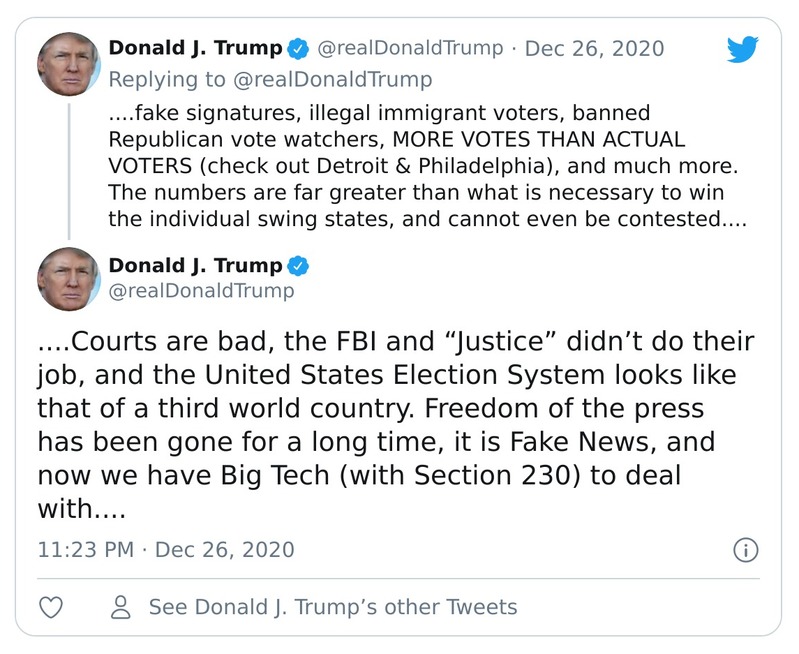
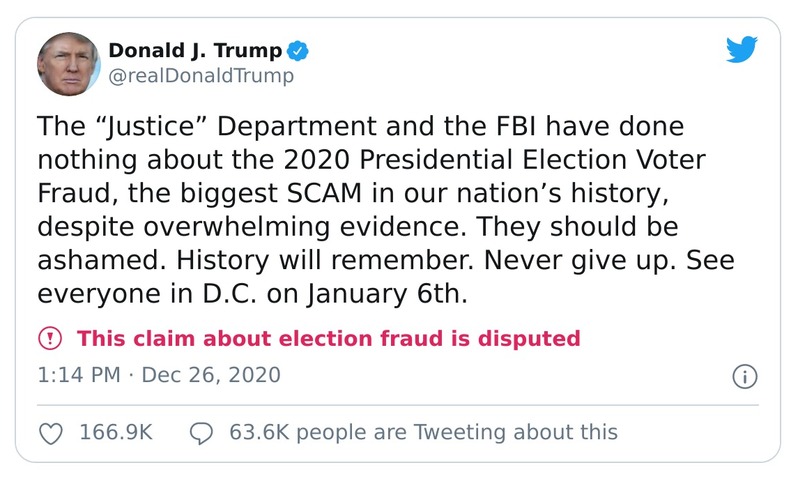
On December 26, Trump tweeted more lies about the election (calling it “the biggest SCAM in our
nation’s history”), attacked the FBI, the Justice Department, and the courts for
following the rule of law, and referenced his January 6 “Save
America” rally.
The rally and its aftermath were
top of mind for Trump’s militant supporters. That day, the Secret Service received
intelligence that the Proud Boys
“think they will have a large enough group to march into DC armed and will
outnumber the police so they can’t be stopped….Their plan is to literally kill
people.”
That same day, Trump ally Scott Perry texted Mark Meadows, suggesting
that the administration elevate Jeffrey Clark to attorney general if they hoped
to stay in power. This was one of at least 62
texts with Meadows after
the election (in addition to dozens of contacts with Trump’s outside lawyers).
Clark was mentioned because
Trump’s attorney general of less than a week, Jeffrey Rosen, insisted on
following the rule of law. On December 27, Trump pressured Rosen to review “election fraud” in Pennsylvania and Arizona that former
attorney general William Barr had found to be inconsequential.
Rosen reportedly told Trump that the Department of Justice “can’t, and won’t, just flip a
switch and change the election.”
In response, Trump told Rosen to “just say that the
election was corrupt” and “leave the rest to me and the [Republican]
congressmen.”
Trump’s allies were in on a “Strategic
Communications Plan,” a document detailing an aggressive disinformation campaign filled with
talking points about fraud in swing states, messaging channels, and target
audiences—even though Trump was told that the fraud talking points were false by “at least 11 aides and
close confidants.”
Trump also tried to get Rosen to sign on to a lawsuit
(which had already been rejected by the Department of Justice’s Office of Legal
Counsel) asking the Supreme Court to toss out electoral college votes in six
states Biden had won and order
a “special election.”
Trump wasn’t the only one badgering Rosen. Jeffrey Clark made
five cracks at the new attorney general, trying to get
him to challenge election results in key states lost by Trump.
Rosen’s second-in-command also felt the heat. Coaxed by
Trump, Pennsylvania representative Scott Perry called Richard Donoghue, the Deputy Attorney General, to try to get the Justice
Department to review debunked voter fraud claims in Pennsylvania. Perry also tried
to convince Donoghue to grant more power to Trump loyalist Jeffrey Clark, who wanted to scour election results for
any data which could be exploited for GOP messaging.
On December 28, Clark peddled
conspiracy theories around the Justice Department and sent a
message to Jeff Rosen and Richard Donoghue requesting their sign-off on a letter (conveniently typed on official Department of
Justice letterhead) which asked Georgia’s Republican legislature to call a
special session to investigate election “irregularities” and choose a slate of illegitimate
electors for Trump.
In the words of historian Heather Cox Richardson, “Clearly,
there was no time to actually conduct another investigation into the election
before January 6; the letter was designed simply to justify counting out
Biden’s ballots or, failing that, to create popular fury that might delay the
January 6 count.”
Donoghue responded via email that
signing such a letter was “not even in the realm of possibility.”
Without the backing of Justice
Department leadership, Clark worked with aide
Ken Klukowski (who had started at the DOJ on December 15)
to gather witnesses to provide “testimony” of voter fraud. The January 6 House Select Committee revealed
that voter suppression expert Ken Blackwell emailed Mike Pence’s office to ask him to meet with
Klukowski and John Eastman. According to
Jeremy Stahl of Slate, “this email was the first piece
of public evidence linking Eastman directly to the efforts to use the
[Department of Justice] to change the outcome of the election.”
Another
effort to change the outcome of the election came from William Olson, the
lawyer Trump had spoken to on Christmas. Warning that “time is about to run
out” for their plans, Olson sent a letter to Trump
saying that the Office of White House Counsel and Attorney General Rosen were
failing the president.
Olson
suggested the White House replace Rosen within 24 hours and re-file a case
along the lines of Texas v. Pennsylvania,
which
would nullify the electoral college votes of
Georgia, Michigan, Pennsylvania, and Wisconsin. If the Supreme Court didn’t
rule in Trump’s favor, the president could act unilaterally, since “that body
was never intended to be the final authority on matters of this sort.”
Rupert
Murdoch’s New York Post disagreed. The day prior, the right-wing
newspaper ran an editorial telling Trump “Give it
up, Mr. President—for your sake and the nation’s.” The editorial opened with
“Mr. President, it’s time to end this dark charade,” mentioned that the electoral
college vote count on January 6 was merely pro forma, and called Trump
to account for “cheering for an undemocratic coup.”
Even as Fox
continued to placate viewers by feeding doubt about 2020, Post owner
Murdoch congratulated the editor-in-chief (Col Allen) on a “great” editorial
and added that it might convince Trump to throw in the towel—“If he doesn’t tweet it’ll mean he’s read it and stopped to think.”
If Trump did pause to collect his thoughts, it was brief. In
a December 29 conversation with Mike Pence, Trump
claimed the Department of
Justice had found “major infractions” of election law, which wasn’t true.
Mark Meadows did his part for The
Big Lie that day when he urged Attorney General Rosen and Deputy Attorney
General Richard Donoghue to consider the right-wing
myth that the number of
votes cast in Pennsylvania was larger than the number of registered voters in
the state and to take a look at “Italygate” (a theory that Biden supporters
in Italy had used satellites to change a decisive number of votes in swing
states from Trump to Biden).
Rosen also heard from Trump’s
personal assistant Molly Michael. Michael emailed Rosen, Donoghue, and Solicitor General Jeffrey
Wall a legal complaint claiming that the six swing states Trump had lost by the
narrowest margins (Nevada, Wisconsin, Pennsylvania, Michigan, Georgia, Arizona)
had violated the Electors Clause of the Constitution, along with a request to
file a case before the U.S. Supreme Court.
The pressure on Rosen continued on
December 30. Outside attorney Kurt Olsen called Jeff Rosen and said that Trump expected him to file Michael’s Supreme
Court lawsuit by noon that day.
Rosen didn’t budge.
Meanwhile, Trump strategist Steve Bannon called the president and suggested he lure Mike Pence back to Washington
(from a skiing vacation) in order to pressure him into refusing to accept Biden
electors during the January 6 certification. The goal was to convince Pence to “kill
the Biden presidency in the crib.”
As Trump worked on Pence, presidential
aspirant Josh Hawley, a Missouri Republican, became the first senator to announce his intent
to object to electors for Joe Biden on January 6.
While Hawley made a savvy play for
future Republican primary voters, Trump’s minions continued to pressure the Justice
Department (DOJ). In two of
five known emails Mark Meadows sent asking the DOJ to review tinfoil-hat conspiracy theories,
Trump’s chief of staff that day sent Justice officials disinformation about alleged voter fraud in Fulton County, Georgia. (Meadows also forwarded debunked conspiracy theories to “the FBI, Pentagon, National Security Council, and Office of the Director of National Intelligence.”)
Late that night, Republican Scott
Perry of Pennsylvania texted Jeffrey Clark. Among the key lines in the exchange were:
Perry: “[Trump] seems very happy with your response. I read it just as you
dictated.”
Clark: “I’m praying. This makes me quite nervous. And wonder if I’m worthy or
ready.”
Perry: “You are the man. I have confirmed it. God does what
he does for a reason.”
God decreed that Ken Chesebro email John Eastman and other coup legal staff
on December 31. Chesebro asked Eastman’s opinion about getting Clarence
Thomas (who oversees the circuit courts in Georgia) to issue a stay
of the Georgia results, thereby gaining legal (and PR) legitimacy for the idea
that other swing state results were potentially fraudulent, and thus ripe to be
overturned by state legislatures.
Among those states was Arizona. The
White House left a
message that day for Clint
Hickman, the Republican head of the Maricopa County Board of Supervisors,
asking for a call back. This was one of numerous Republican attempts to get
Hickman to issue arbitrary rulings in Trump’s favor in order to flip a state
Trump had lost by more than 10,000 votes.
Mindful of election laws and legal
liability, Hickman didn’t return this call (or the one the White House placed three
days later).
The main event on the final day of
2020 involved the Department of Justice. Frustrated that he couldn’t get the
new attorney general to break the law, Trump invited Rosen and Donoghue to the
White House.
At the meeting, Trump reportedly said that he was considering
replacing Rosen with Jeffrey Clark because Rosen hadn’t been aggressive enough
in investigating voter fraud. Trump wanted voting machines seized by the
Justice Department, but was told by Rosen that the DOJ had “no legal authority”
to do so. If any such authority existed, it was held by the Department of Homeland Security (DHS).
After the meeting, “Trump then called Ken
Cuccinelli, the
DHS acting deputy secretary, and falsely told him that the acting attorney
general had just said that it was Cuccinelli’s job to seize voting machines
‘and you’re not doing your job.’”
As Trump tried
to cling to power, Chip Roy, a supporter of Trump’s election challenges a few weeks
earlier, texted Mark Meadows that it was
time to give up:
“The president should
call everyone off. It’s the only path. If we substitute the will of states
through electors with a vote by congress every 4 years…we have destroyed the
electoral college.”
Proud Boy leader
Enrique Tarrio had no such concern about constitutional niceties. In an
end-of-year text to fellow right-wing activists, he wrote “Let’s
bring this new year in with one word in mind: revolt.”
***
On January 1, 2021, Jeff Rosen
received a 13-minute YouTube video about “Italygate” from
Mark Meadows (which Meadows had gotten the day prior from Scott Perry). Meadows also asked Rosen to send Jeffrey
Clark to Georgia, presumably so that Clark could find something, anything which
could be construed as “voter fraud.”
Pressure on Pence continued. Trump
loyalist and director of presidential personnel Johnny McEntee texted a memo to Greg Jacob (Pence’s chief of staff),
headlined with the words “Jefferson Used His Position as VP to Win,” a fanciful
interpretation of the 1800 presidential election.
McEntee’s memo took a hit when
three Republican judges (including a Trump-appointed judge) in Texas rejected Arizona representative Louie Gohmert’s lawsuit
claiming Mike Pence could unilaterally pick and choose which electors to accept
on January 6.
Following the ruling, Trump called
Pence. The president was
upset that Pence had sided with the Department of Justice, who had opposed
Gohmert’s lawsuit. Pence told Trump that he was bound by the Constitution to
follow the will of the voters.
Trump reportedly told him, “You’re
too honest.”
Kenneth Chesebro was more to
Trump’s liking. In a message to John Eastman and Boris Epshteyn, Chesebro
listed 14 talking points for congressional Republicans to
ignore the spirit of the Electoral Count Act on January 6. Key among these ideas was the suggestion
that Republican Josh Hawley break 133 years of precedent and oppose the rule
that each member of Congress who objected to certifying a state’s electoral
votes had no more than five minutes to state their case.
Breaking the precedent would allow
endless objections, buying Trump more time for a miracle court decision, for Pence
to give in and pick the electors himself, or for Pence to step down and let Republican
senator Chuck Grassley take over and do Trump’s bidding.
January 2, 2021 was a busy day in the
annals of failed election theft.
Eleven
Republican senators, including former and likely future presidential candidate
Ted Cruz, made a joint statement in which they referred to ill-defined fraud and advocated “an emergency 10-day audit of the election returns in the
disputed states.”
The senators’ public pretense was that the audit
was necessary in order to assuage millions of Americans who had doubts about
the legitimacy of the 2020 election. Polls cited showed that one-third of
independents, two-thirds of Republicans, and 39% of all voters held the baseless
belief that the
election had been “rigged.”
In plain English, the senators were contending
that since four out of every 10 Americans were gullible enough to believe ludicrous
and self-serving Republican lies about an election they clearly lost, a 10-day
“audit” giving Republicans more time to peddle ludicrous and self-serving lies
about an election they clearly lost was necessary to “restore faith in American
Democracy.”
While his congressional
sycophants performed Kabuki theater, Trump made another attempt to flip
Georgia. After 18 requests from Mark Meadows, Georgia
Secretary of State Brad Raffensperger consented to a call with Trump.
During an infamous 67-minute conference call, Raffensperger debunked
Trump’s conspiracy theories and pointed out that multiple recounts hadn’t come
close to reversing Trump’s Georgia loss. Unbowed by the facts, Trump tried to bully the Republican Secretary of
State into “[finding] 11,780 votes” for him—just
enough to give Trump Georgia’s 16 electoral college votes.
The Justice
Department wouldn’t bend to Trump’s will either. Jeff Rosen wrote Jeffrey Clark back and said (as his second-in-command Richard Donoghue had already done on
December 28) that he was “not prepared
to sign” a letter asking Georgia’s Republican legislature to “investigate”
trumped-up allegations of fraud.
Evidence or no evidence, plans continued
for January 6.
Trump
called 300
Republican state legislators, telling them they could overrule the will of the
voters in their states and put forward fake electors.
Republican congressman Jim Jordan
of Ohio took part in a conference call with Rudy Giuliani and other Trump
allies to
discuss “strategies for delaying the January 6th joint
session” and ways to coax Trump supporters to D.C. through social media.
According
to Mark Meadows aide Cassidy Hutchinson, “the terms ‘Proud Boys’ and ‘Oath
Keepers’” came up “when [Rudy] Giuliani was around.” After a January 2 meeting between
Rudy Giuliani, Mark Meadows, and other White House officials, Giuliani told Hutchinson,
“We’re going to the Capitol! It’s going to be great!”
Hutchinson asked Meadows for
clarification.
Meadows told her “There’s a lot going on…things might get real,
real bad on January 6.”
Department of Homeland Security
employees felt the
same way, “[noting] that people were sharing
a map of the Capitol building online. Those employees messaged each other,
saying they ‘feel like people are actually going to try and hurt politicians.
Jan 6th is gonna be crazy.’”
One politician
who may have been targeted was current senator and former Republican
presidential candidate Mitt Romney, who received a call that day from independent
senator Angus King. King warned Romney about violence at
the Capitol—and potentially violence directed toward him. Romney texted Senate
majority leader Mitch McConnell:
“In case you have not heard this, I
just got a call from Angus King, who said that he had spoken with a senior
official at the Pentagon who reports that they are seeing very disturbing
social media traffic regarding the protests planned on the 6th. There are calls
to burn down your home, Mitch; to smuggle guns into DC, and to storm the
Capitol. I hope that sufficient security plans are in place, but I am concerned
that the instigator—the President—is the one who commands the reinforcements
the DC and Capitol police might require.”
Romney said that McConnell did not
reply.
On January 3, 2021, Mark Meadows
received
a text which said, “I heard Jeff Clark is [going to
replace Jeff Rosen] on Monday
[January 4]. That's amazing. It will make a lot of patriots happy, and I'm
personally so proud that you are at the tip of the spear, and I could call you
a friend.”
As reported at Talking Points Memo, “Clark planned to send
letters to state legislatures saying that the DOJ had found evidence suggesting
that the election results were in doubt, while advising state lawmakers to
consider tossing out Biden’s electors and replacing them with the fake electors
slates that the Trump campaign had created.”
That afternoon, deputy White House
counsel Patrick Philbin, who believed Trump should follow the rule of law, told
Clark that the fraud allegations were baseless and that a fake elector coup
would cause “riots in every major city in the United States.”
Reportedly,
Clark replied, “Well…that’s why there’s an Insurrection Act.”
Call
logs revealed by the January 6 House Select Committee showed that Clark called the White House four times that day. By the fourth call—at 4:19 p.m.—Clark was officially
referred to in the logs as the “acting Attorney General.”
In testimony before the committee, Jeff Rosen said that
Clark “told me that the
timeline had moved up and that the president had offered him the job and that
he was accepting it.” Rosen “wasn’t going to accept being fired by [a]
subordinate,” so he arranged a meeting at the White House.
Rosen
told
congressional investigators that Trump began the meeting by saying, “One thing we know is you,
Rosen, aren't going to do anything to overturn the election,” and implied that
he could keep his job if he agreed to send Jeffrey Clark’s letter (written by Ken Klukowski, see
December 28) to Georgia legislators.
For
two-and-a-half hours, Clark tried to convince Trump that he should become
attorney general while Richard Donoghue, Pat Cipollone, Jeff Rosen, and
Assistant Attorney General for the Office of Legal Counsel Steven Engel
argued against the elevation of Clark.
Engel
told the January 6 House Select Committee:
“I said, ‘Mr. President you’re talking
about putting a man in that seat who has never tried a criminal case, who has
never conducted a criminal investigation, and he’s telling you that he’s going
to take charge of the department’s 115,000 employees, including the entire FBI,
and turn the place on a dime and conduct nationwide criminal investigations
that will produce results in a matter of days. It’s impossible, it’s absurd, it
is not going to happen, and it is going to fail.’
“He has never been in front of a trial
jury, a grand jury, he’s never even been to [FBI Director] Chris Wray’s office.
I said at one point, ‘If you walked into Chris Wray’s office, one, would you
know how to get there, and two, if you got there, would he even know who you
are? And do you really think that the FBI is going to suddenly start following
your orders?’ It’s not going to happen. He’s not competent.”
Trump
backed off of his threat to replace Rosen after “Donoghue and Assistant Attorney General for the Office of Legal
Counsel Steve Engel made clear that there would be mass resignations at [the
Department of Justice] if Trump moved forward with replacing Rosen with Clark.”
Though
he left Rosen in place, Trump fired the U.S.
attorney who covered the Atlanta area, Bjay Pak. Trump said Pak hadn’t done
enough to uncover fraud in his district. Pak’s replacement, Trump loyalist
Bobby Christine, later concluded that “There’s just nothing to” Trump’s claims of voter fraud in
Fulton County, where Biden amassed a huge share of his Georgia votes.
While
manipulating the electoral college certification was Trump’s main focus, many
political insiders had concerns that the president might fall back on the
Insurrection Act—especially if pro-Trump protesters clashed with left-leaning forces
on January 6. Earlier that day, all ten living defense secretaries penned an op-ed in the Washington
Post aimed at top decision makers on the Trump administration’s national
security team.
The
signatories said that acting Defense Secretary Christopher Miller and those
working under him “are each bound by oath, law and precedent to facilitate the
entry into office of the incoming administration, and to do so wholeheartedly.
They must also refrain from any political actions that undermine the results of
the election or hinder the success of the new team.”
Trump and his
collaborators weren’t yet accepting that there would be a “new team” on January
20.
On January
4, 2021, Republican senators were given a Team Kraken pitch to seize voting machines and delay the official
January 6 certification.
Kevin Cramer,
a conservative Republican senator who had voted with Trump 94% of the time, said
that the presenters wheeled out “some of the most fantastical claims” about interference
from Venezuela or China as a justification for this extraordinary step. Attending
via Zoom was Wisconsin senator Ron Johnson, who would try to pass off fake electors for Wisconsin and
Michigan on January 6.
Another
Wisconsin Republican who was in on the plot was Mark Jefferson, executive
director of the state party. With the fake Wisconsin electoral certificates hung up in the mail, Trump’s
lawyers were becoming desperate. In a text to a colleague, Jefferson said, “Freaking Trump idiots
want someone to fly original elector papers to the senate President….They’re
going to call one of us to tell us just what the hell is going on.”
While Republicans
played chicken with democracy, security concerns grew. As revealed during the January 6
House Select Committee hearings, here summarized by historian
Heather Cox Richardson:
“On January 4, National Security
Advisor Robert O’Brien called [Mark] Meadows to warn of violence on January 6.
The Secret Service and White House Deputy Chief of Staff Anthony Ornato, who
was in charge of security protocol to protect anyone covered by presidential
protection, also warned of coming violence.”
Despite
these warnings, General Mark Milley was
turned down when he suggested to Trump cabinet members that permits for a January 6 protest at
the Capitol building be revoked due to the possibility of violence.
Still hoping to avoid a
messy, violent coup in favor of a bloodless, lawyerly coup, Trump’s
outside attorney John Eastman presented Mike Pence with a
six-step plan to toss the electoral
college votes from seven states Trump lost.
If Pence carried out the plan, neither candidate
would have 270 electoral college votes, which would throw the election to the House
of Representatives, allowing Republicans to override the will of American voters.
Eastman’s plan was in clear violation of the
Electoral Count Act passed in the late 19th Century; Pence’s counsel
Mark Jacob would later say that Eastman’s reading of 133 years of election precedent was
“essentially entirely made up.”
A second option was to have Pence adjourn the
counting, allowing time for states Trump had lost to submit fake electors.
Eastman had advocated for this scheme on a Steve Bannon podcast two days earlier and sketched
out its details in a two-page
memo to Republican senators
Lyndsey Graham and Mike Lee, both of whom would later conclude that Trump’s fraud
claims were baseless.
Speaking
to Jim Acosta on CNN, famous Watergate reporter Carl Bernstein said of the Eastman memo, “I think what we are seeing in these memos particularly
are blueprints for a coup….The actual blueprints in document form in
which the president of the United States, through his chief of staff, is
sending to Mike Pence’s, the vice president’s, staff a blueprint to overturn an
election, a blueprint for a conspiracy led by a president of the United States
to result in an authoritarian coup in which the election is stolen.”
The nerve
center of the authoritarian coup attempt was a war room at the Willard Hotel,
one block from the White House. In the weeks before January 6, Trump’s lawyer Rudy
Giuliani led a team of conspirators who attempted to overturn Biden’s election victory.
Interlocking strategies included injecting disinformation about voter fraud
into the right-wing media bloodstream, encouraging swing state Trump supporters
to pressure their state legislators to block certification of Biden’s win, pushing
state legislators directly to block certification of Biden’s victory, and
trying to convince Mike Pence that he had the power to deny state-certified electoral
college votes.
At various
times Giuliani was joined by Steve Bannon, John
Eastman, Bernard Kerik, Phil
Waldron, and
Roger Stone, who had Oath Keepers as
bodyguards along with connections to both Stewart Rhodes
(leader of the Oath Keepers) and Enrique Tarrio (leader of the Proud Boys).
Details of the Willard team’s agenda were revealed in a document given to the January 6 House Select Committee by Bernard
Kerik’s attorney. (See December 17)
While
Trump and his war room cabal brainstormed ways to manipulate Mike Pence, other Republicans
gave the vice president sound interpretations of constitutional law. Conservative judge J. Michael Luttig told Pence’s
staff that there was no legal basis for him to reject electoral college votes, advice also passed on by conservatives John Yoo and former vice president Dan
Quayle.
The day before
the official counting of electoral ballots, January 5, 2021, Mike Pence’s
attorney, Greg Jacob, released
a three-page
memo which pointed out that the rejection of Joe Biden’s electors would be a flagrant violation of the 1887 Electoral College Act.
Pence’s chief
of staff, Marc Short, called a meeting with Timothy
Giebels, the head of the vice president’s security detail. Giebels was told
that due to Pence’s reluctance to meddle with the electoral count, Donald Trump
“was going
to turn publicly against the vice president, and there could be a security risk
to Mr. Pence because of it.”
Meanwhile, even some of Trump’s most
loyal staff were getting skittish about Trump’s proposed power grab. Trump
Communications Director Jason Miller, tasked with putting out an official White
House statement about the fake electors, asked other communications staff via text “How
best [to] proceed tomorrow so we don’t look like a donkey show, particularly on
the comms/media front?”
Justin Clark, deputy campaign manager, responded that “Here’s the thing the way this has morphed it’s a crazy
play so I don’t know who wants to put their name on it.”
Pennsylvania’s fake electors were having the same reluctance. As
reported in the Washington Post, general counsel for the PA GOP
Thomas W. King III emailed a Trump campaign official “saying
he understood that the Trump electors in Pennsylvania had been told they would
receive ‘indemnification by the campaign if someone gets sued or worse.’
“They
were also to receive ‘a legal opinion by a national firm and certified to be
accurate by a Pa. lawyer,’ King wrote. Instead, he wrote, they got a memo from Kenneth
Chesebro…[who] described the plan in Pennsylvania as ‘dicey’ because state law
calls for the governor, who at the time was a Democrat, to approve any elector
substitutions.
“King
made changes to the electors’ paperwork to make clear that the Republican
electoral votes were valid only with the finding of a court order that could
not be appealed.” (King would later tell the Post, “No one ever offered
indemnification….Any document that any
lawyer looks at needs to be accurate.”)
Oddly enough, while
fake electors tried to cover their asses, an article appeared that day about
Republican senator/Trump ally Chuck Grassley overseeing the electoral college
vote if Pence somehow failed to show up.
Grassley’s
exact words were “If the vice president isn’t there,
and we don’t expect him to be there, I will be presiding over the Senate and
obviously listening to the debate without saying anything.” (Grassley’s office
later said the statement was misinterpreted by the media).
The
Capitol was supposed to be closed to the
public that Tuesday due to Covid-19, but Republican House member Barry
Loudermilk of Georgia gave a tour. The January 6 House
Select Committee would later tweet that “Individuals on the tour photographed/recorded areas
not typically of interest to tourists: hallways, staircases and security
checkpoints.” One of the people on the tour
marched to the Capitol the following day while threatening violence
against Democratic members of Congress.
Democrats
weren’t the only ones under threat. Republican representative Debbie
Lesko was caught
on tape asking congressional leadership to “come up
with a safety plan for members” because “I’m actually very concerned about
this, because we have who knows how many hundreds of thousands of people coming
here. We have Antifa. We also have, quite honestly, Trump supporters, who
actually believe that we are going to overturn the election. And when that
doesn’t happen – most likely will not happen – they are going to go nuts.”
Aware of the
potential for violence, Washington D.C. mayor Muriel
Bowser requested National Guard backup, but Donald Trump’s Defense Department
handcuffed the Guard’s mission. According to Paul Sonne, Peter Hermann, and Missy
Ryan of the Washington Post, “the Pentagon prohibited the District’s
guardsmen from receiving ammunition or riot gear, interacting with protesters
unless necessary for self-defense, sharing equipment with local law
enforcement, or using Guard surveillance and air assets without the defense
secretary’s explicit sign-off.”
In addition,
“The D.C. Guard was also told it would be allowed to
deploy a quick-reaction force only as a measure of last resort,” which forced
local D.C. officials to get approval from Trump’s Defense Department for rapid
deployment, a bureaucratic hurdle which hadn’t existed previously.
While
the Secret Service “warned the U.S. Capitol
Police
that their officers could face violence at the hands of supporters of former
President Donald Trump,” Mark Meadows sent out an email
demanding that the National Guard “protect
pro-Trump people.” A statement from the White House Office of the Press Secretary hyped the threat of
left-leaning protesters, saying “President Trump will not allow Antifa, or any
terrorist organization, to destroy our great country.”
Trump mirrored this with a tweet threatening members of antifa who showed up in D.C. on January 6. There
was speculation later on that this messaging could have been put in place to give Trump
cover to declare a national emergency on January 6, if anti-Trump protesters
showed up to fight pro-Trump protesters. A national emergency could have
allowed Trump to seize voting machines according to Phil Waldron’s 38-page PowerPoint titled “Election Fraud, Foreign Interference & Options for January
6” (see November 25, January 4).
As
D.C. girded for trouble, Trump riled his supporters up with a 5 p.m. tweet which read,
“Washington is being inundated with people who don’t want to
see an election victory stolen by emboldened Radical Left Democrats….Our Country has had enough, they won’t
take it anymore!”
This call out to the
troops coincided with a pro-Trump event at Freedom Plaza that night. Speaking
at the rally were Trump allies who were considered too extreme to speak at the
main event on January 6—Alex Jones, Ali Alexander, Michael Flynn, and Roger
Stone.
Stone told those in attendance they were in an “epic
struggle for the future of this country between dark and light, between the
godly and the godless, between good and evil. And we will win this fight or
America will step off into a thousand years of darkness.”
According
to deputy press secretary
Sarah Matthews, during an Oval Office meeting which took place while
music was booming at Freedom Plaza (just half
a mile from the White House), “[Trump] was in a very good mood. And I say that
because he had not been in a good mood for weeks leading up to that, and then
it seemed like he was in a fantastic mood that evening.”
Deputy Press Secretary Judd Deere concurred, saying Trump was “animated” and “excited about
the next day. He was excited to do a rally with his supporters.”
At the meeting, Trump discussed the
march to the Capitol which would follow his speech at the Ellipse on January 6.
Though it was known to pro-Trump activists and administration figures,
the march to the Capitol wasn’t
public knowledge. As January 6 committee
member Stephanie Murphy would later say, “the evidence confirms that this was
not a spontaneous call to action, but rather was a deliberate strategy decided
upon in advance by the president.”
Late that evening, Trump called his allies at the Willard Hotel and
strategized about how they could delay the vote count long enough to get three
swing states to reject Biden’s electoral votes and send false electoral votes
to the Capitol.
One of the key
strategists at the Willard was Steve Bannon. Liz Cheney, future vice chair of the
January 6
House Select Committee, would later say, “Based on the
committee’s investigation, it appears that Mr. Bannon had substantial advance
knowledge of the plans for January 6th and likely had an important role in
formulating those plans.”
On his podcast
the night of January 5, Steve Bannon concluded ominously:
“It’s not going to happen
like you think it’s going to happen. OK, it’s going to be quite extraordinarily
different. All I can say is, strap in….You made this happen and tomorrow it’s
game day. So strap in. Let’s get ready.”
***
Prior to January 6, 2021, the electoral college vote count
and certification had been purely
ceremonial.
But since none of Trump’s tactics to overthrow the election
had worked, the president’s fundraiser Caroline Wren, campaign
operative Katrina Pierson, chief of
staff Mark Meadows, Republican
members of Congress, and right-wing activists planned one final, grand charade: a “Save
America” rally followed by a stealth march to the Capitol.
Activists
involved in the planning bought burner phones with cash to
secretly communicate with members of the White House, including chief of staff Mark Meadows. It would
later come out that “Trump’s political operation reported paying more than
$4.3 million to people and firms that organized the Jan. 6 rally since the
start of the 2020 election.”
According
to Hunter Walker of Rolling Stone, event
planners also collaborated with fringe-right members of Congress such as Marjorie
Taylor Greene, Louie Gohmert, Paul Gosar (later to become
one of the biggest
defenders of the insurrectionists), Madison
Cawthorn (who spoke at the January 6 rally), Andy
Biggs, and Lauren Boebert.
Two of Walker’s sources (both
event planners) said that Gosar—who allegedly made phone calls to the sources
on January 6—promised that Trump would grant them pardons
if they incurred any legal trouble as a result of the rally. Right-wing
activist Ali
Alexander, one of the organizers of the “Wild
Protest,” had also mentioned collaborating with Gosar and Biggs in a video which was later deleted.
The
rally and the march were a prelude to the formal challenge by 13 Republican
senators and 140 House members to Joe Biden’s electoral college victory. The
challenge would consist of regurgitated fraud claims which had been rejected
for lack of merit in more than 60
judicial cases, by judges of all ideological stripes.
Trump
trade adviser Peter Navarro would later brag about his role in
recruiting members of Congress. He and Steve Bannon came up with a plan called
“the Green Bay sweep.” The aim was to get challengers to delay the electoral
vote certification as long as possible in hopes that several hours of televised
hearings (full of Republican claims about a “rigged election”) would pressure
Mike Pence to reject electors from Biden states and end 231 years of American
democracy.
While the
suits conspired, Trump’s ground troops stood by. Alongside the Oath Keepers,
who “were expecting Trump to invoke the
Insurrection Act” so that he would have a false pretense to call up the U.S.
military and maintain control of the government by
force, 250-300 Proud Boys had plans to pre-empt the
certification by seizing government offices and
making demands on behalf of the losing presidential candidate. The leaders of
the two groups had met in a D.C. underground
parking lot the day prior.
According to Mark Meadows’ aide
Cassidy Hutchinson, as of
8:00 a.m., “intelligence
reports were already coming in that some of the people near the Ellipse, where
Trump was to speak, were dressed in body armor and armed with Glock-style
pistols, shotguns, and AR-15s, along with other weapons.”
When
deputy chief of staff Anthony Ornato told Meadows about weapons confiscated
by law enforcement, “Meadows appeared uninterested and didn't
look up from his phone…saying: ‘All right, anything else?’”
At 8:24 a.m., Eric Waldow, a deputy chief in the
Capitol Police Force who was “responsible for directing officers’ movements,” sent a message over
Capitol Police Radio for his fellow officers to “watch out for anti-Trump
protesters in the massive pro-Trump crowd.”
There
was concern of violence between Trump’s white supremacist followers and
left-wing activists, but this would turn out to be an empty threat. Prodded to
stay home with hashtags #Jan6TrumpTrap and
#DontTakeTheBait, the left’s presence at the rally was minimal
to nonexistent.
With just over four hours to go
before the certification was to start, Trump allies continued their attempts to
overturn the will of the American people.
The speaker of the Arizona House,
Rusty Bowers, received a call from House of Representatives member Andy
Biggs asking him to reject Biden’s legitimate electors for the state of Arizona.
This was one of many requests from conspirators to Bowers (including a call
from Rudy Giuliani, who had earlier admitted to Bowers that “we have lots of theories, we just
don’t have the evidence”).
Bowers refused to buckle, even as his
family had been doxxed, with Trump supporters shouting epithets outside of
his home while his daughter was inside
dying of cancer.
One of
the main conspirators was Representative Jim
Jordan. Jordan and Trump spoke for ten minutes that morning. Jordan would later gum
up the works during the certification, after the Capitol was cleared.
Trump also received a call around
11:04 a.m. from Republican senator David Perdue.
It was the last
call recorded in the
official White House logs until 6:54 p.m. that evening.
The most consequential conversation
Trump had was with vice president Mike Pence, whom Trump had already pressured twice that day, with tweets at 1:00 a.m. and 8:17
a.m.
Around 11:20 a.m., Trump called
Pence from the Oval Office. Several witnesses were present. Marc Short, Pence’s
chief of staff, estimated that the call lasted 15-20 minutes.
According
to reporters Kyle Cheney
and Betsy Woodruff Swan, “Multiple people familiar with the testimony given
to the [January 6] committee about the call offered a consistent account. One
of those people — granted anonymity to speak candidly — said witnesses
described the conversation as beginning relatively pleasantly, with Trump
embracing the legal advice he was given about Pence’s ability to send the
election back to the states.
“Although people in the Oval Office couldn’t hear him, Pence had
clearly rejected Trump’s entreaties, the person indicated. Witnesses have said
listeners in the room were surprised because it was the first time they
recalled Pence saying no to Trump. The call deteriorated and Trump grew
frustrated.”
Trump told Pence “You can either go down in history as a patriot…or you
can go down in history as a pussy.”
Pence chose to go down in history as a patriot.
Just before the count began, he released a public letter confirming that he
lacked the constitutional authority to unilaterally decide which electoral college votes
to accept.
Trump responded to this pushback from his previously subservient #2 by “reinserting language [into
his rally speech] that he had personally drafted earlier that morning—falsely
claiming that the Vice President had authority to send electoral votes to the
states—but that advisors had previously successfully advocated be removed.”
This change in
emphasis increased the threat risk for Vice President Pence. As reported by historian Heather Cox
Richardson, the “Save America” rally that day was simmering with latent
violence:
“Text messages
between [Cassidy] Hutchinson and [Deputy Chief of Staff Anthony] Ornato show
that Trump was ‘furious’ before the Ellipse rally because he wanted photos to
show the space full of people and it was not full because law enforcement was
screening people for weapons before they could go in. Trump wanted the
screening machines, called magnetometers, to be taken down.”
According
to Hutchinson’s
testimony before the January 6
House Select Committee, “I overheard the president say something to the
effect of, you know, ‘I don’t even care that they have weapons. They’re not
here to hurt me. Take the f-ing mags away. Let my people in. They can march to
the Capitol from here. Let the people in. Take the f-ing mags away.’”
The speeches included
several incitements
to violence.
Lead-off
speaker Mo Brooks, clad in body armor, said, “Today is the day American patriots start taking down
names and kicking ass!”
Addressing
congressional Republicans
who intended to honor the will of American voters, Donald Trump, Jr. said, “We’re coming for
you, and we’re going to have a good time doing it.” If they didn’t change their
minds and oppose Biden’s certification, “I’m gonna be in your backyard in a couple of months.”
Rudy Giuliani said, “Let’s have trial by combat,” which was “an eerie
reference to battles to the death in the series ‘Game of Thrones.’”
Donald Trump headlined at noon.
Talking tough from behind bulletproof glass, he unleashed a torrent of self-serving lies about
the election, “used the words ‘fight’ or ‘fighting’ at least 20 times,” and said “You’ll never take back our country with weakness. You have
to show strength. You have to be strong.”
Over at the Capitol, with the clock
running down, Republicans were still scheming to get illegitimate electors to
Mike Pence. At 12:37, an aide to Republican senator Ron Johnson texted a Pence aide about
“alternate” electors for Wisconsin and Michigan that Johnson wanted to pass
off. In response, the Pence aide said, “Do not give that to [Pence].”
By 12:54 p.m.—six
minutes before House Speaker Nancy Pelosi was scheduled to bring Congress to
order—Trump supporters had busted through barrier fences
around the U.S. Capitol.
Five-ten minutes after the formal
count had begun, Trump finished his speech with a call to action:
“We
will never give up; we will never concede….We will stop the steal. We’re going
to walk down Pennsylvania Avenue, and we’re going to the Capitol…We’re going to
try and give our Republicans, the weak ones…the kind of pride and boldness that
they need to take back our country.”
The march had been hidden—by
design—from the general public. In a January 4 communication, conservative organizer Kylie Jane Kramer had texted MyPillow CEO
Mike Lindell that “It
can also not get out about the march because I will be in trouble with the
national park service and all the agencies but POTUS is going to just call for
it ‘unexpectedly.’”
Trump’s
advisors had composed a tweet which mentioned the march.
Trump read the tweet, but didn’t send it, leaving Capitol security in the dark
about what they were about to face.
In the presidential limousine, the Secret Service
refused to take Trump to the Capitol. Cassidy Hutchinson told the January 6
House Select Committee that the outgoing president threw a
fit as he “attempted
to grab the steering wheel and then lunged at the agent driving” the vehicle.
Trump’s demand (“I am the fucking president, take me up to the Capitol now”)
went unheeded.
At 1:14 p.m.,
vice president-elect Kamala Harris was evacuated from Democratic National
Committee headquarters, where a pipe bomb was found. Another pipe bomb, placed
by the same suspect the night prior, would
be found at the Republican National Committee headquarters. The motive remains
unknown, but it could have been to draw law enforcement attention away from the
Capitol.
Donald Trump
was in the White House dining
room by
1:25, where he was soon notified about the “violence at the Capitol.”
Doing nothing to stop the
insurrection, President Trump got cozy in front of Fox News. He “asked aides
for a list of senators to call as he continued to pursue paths to overturn his
defeat,” according to White House
press secretary Kayleigh McEnany.
Around the
same time, Trump’s ally, Paul Gosar (who had collaborated with the “Save
America” organizers), began the GOP stalling tactics, objecting to electors
from Arizona. The two houses of Congress separated to “debate” Gosar’s
objection.
At 1:30 p.m.,
insurrectionists overtook police at the back of the Capitol, forcing them inside
the building.
Unaware of the
threat, Congress continued the proceedings. Senate Majority leader Mitch
McConnell said, “Voters, the courts, and the states have all spoken — they've all
spoken….If we overrule them, it would damage our republic forever.”
As McConnell spoke, a crowd of 8,000 equipped
with “riot helmets, gas masks, shields,
pepper spray, fireworks, climbing gear...explosives, metal pipes, [and] baseball bats” surrounded the front of the Capitol.
At 1:39 p.m., Trump had a four-minute call with Rudy Giuliani, who would call several senators
that day to try to derail the certification. They spoke again a half hour
later.
Because
local officials’ authority to order backup had been
taken away by the Trump administration one day before the certification, Capitol police chief Steven Sund had to beg
Trump allies in the Department of Defense for National Guard reinforcements.
Trump’s military officials
stonewalled Sund, who first called for help at 1:49 p.m.
According to testimony before the January 6 House Select
Committee, here referenced by
Professor Heather Cox Richardson, “[Cassidy] Hutchinson went into [Mark] Meadows’s
[White House] office between 2:00 and 2:05 to ask if he was watching the scene
unfold on his television. Scrolling through his phone, he answered that he was.
She asked if he had talked to Trump. He said, ‘Yeah. He wants to be alone right
now.’ [White House Counsel Pat] Cipollone burst into the office and said to go
get the president. Meadows repeated that Trump didn't want to do anything.
Cipollone very clearly said this to Mark—something to the effect of, ‘Mark,
something needs to be done or people are going to die and the blood’s going to
be on your f-ing hands. This is getting out of control.”’
Back at the Capitol, as officer Caroline Edwards later described it to the January 6
committee, “What I saw was just a war scene….There were
officers on the ground. They were bleeding. They were throwing up. I saw
friends with blood all over their faces. I was slipping in people’s blood. I
was catching people as they fell. It was carnage. It was chaos.”
At 2:11
p.m., Trump supporters—heavily
represented by right-wing hate groups, including many former
members of law enforcement and the military—burst through
a police line to storm the
Capitol, the first hostile takeover of America’s seat of government since
1814.
By
2:13, they were inside the
building.
Once inside,
insurrectionists assaulted
Capitol police officers, attacked
journalists, and traumatized members of
Congress and congressional
aides.
Under the
surface appearance of random chaos were a number of determined seditionists
with concrete goals. Some targeted the offices of
specific members of Congress in hopes
of kidnapping them, or worse. Others ransacked
the Senate parliamentarian’s office in an apparent attempt to intercept electoral
college ballots. There were allegations that plotters may have
had help from members of
the Capitol police force and/or Republican representatives
(including
Barry Loudermilk, who had conducted a tour of the Capitol on
January 5, and Ronny Jackson).
At
2:15 p.m., Pat Cipollone texted Mark Meadows that “we need to do something more. They’re literally calling
for the vice president to be f’ing hung.”
Meadows
responded that “You heard [President Trump], Pat. He thinks Mike deserves that.
He doesn’t think they’re doing anything wrong.”
Four minutes
later, Hogan Gidley (the national press secretary for Trump’s 2020 campaign) texted Hope Hicks (counselor to
the president) with a suggestion that Trump put out a request to his followers
to be non-violent.
Hicks replied
that she had suggested as much “several times” on Monday and Tuesday—this was Wednesday—but
“I’m not there.”
The Senate was
called into recess at 2:20 p.m.
The House soon
followed.
At 2:24 p.m., while “America Firsters and other invaders fanned out
in search of lawmakers, breaking into offices and reveling in their own
astounding impunity,” Trump sent out what would become a notorious tweet:
“Mike Pence didn’t have the courage to do what should have
been done to protect our Country and our Constitution, giving States a chance
to certify a corrected set of facts, not the fraudulent or inaccurate ones
which they were asked to previously certify….USA demands the truth!”
As Trump’s deputy press
secretary Sarah Matthews would tell the January 6
House Select Committee, this was exactly what wasn’t needed in that
moment, as Trump was “giving the green light to [the insurrectionists]” who
“truly latch on to every word and every tweet.”
While lawmakers hid from rioters, Trump called Alabama
senator Tommy Tuberville to ask him to stall the electoral college vote
certification whenever (or if) it could safely resume. Trump reached
Tuberville around 2:26 p.m. and was notified that Mike Pence, his wife, his brother, and his
daughter had just been whisked away from the Senate floor. Later reports showed
that seditionists missed Pence and his family by one
minute (or “five to
10 feet” by another account).
An excerpt from I Alone Can Fix It by reporters Carol Leonnig and Philip
Rucker described the scene:
“At that moment, Pence
was still in his ceremonial office — protected by Secret Service agents, but vulnerable
because the second-floor office had windows that could be breached and the
intruding thugs had gained control of the building. Tim Giebels, the lead
special agent in charge of the vice president’s protective detail, twice asked
Pence to evacuate the Capitol, but Pence refused. ‘I’m not leaving the
Capitol,’ he told Giebels. The last thing the vice president wanted was the
people attacking the Capitol to see his 20-car motorcade fleeing. That would
only vindicate their insurrection.
“At 2:26, after a team
of agents scouted a safe path to ensure the Pences would not encounter trouble,
Giebels and the rest of Pence’s detail guided them down a staircase to a secure
subterranean area that rioters couldn’t reach, where the vice president’s
armored limousine awaited. Giebels asked Pence to get in one of the vehicles.
‘We can hold here,’ he said.”
At 2:28, Mark
Meadows received a text from Republican
representative-elect Marjorie Taylor Greene (“Please tell the president to calm
people…This isn’t the way to solve anything”). Meadows would continue to field desperate
pleas from Trump allies to stop the violence over the next half hour.
Around 2:30, Capitol police chief Steven Sund asked Lieutenant
Generals Walter Piatt and Charles Flynn (the brother of Martial Law advocate Michael Flynn) for permission to deploy the National Guard.
Accompanying
Sund were Major General William Walker (the commander of the D.C. National
Guard), Walker’s counsel (Colonel Earl Matthews), and D.C. chief of police
Robert Contee.
Walker
had buses of troops ready
to go.
According
to Colonel Matthews, Piatt told Sund he didn’t like
“the optics” of “having armed military personnel on the grounds of the
Capitol,” though the Defense Department had had no concern for “optics” the
previous June, when they had deployed
armed military personnel at peaceful Black Lives Matter protests.
After
police chief Contee threatened to ask D.C. Mayor Muriel Bowser to have a press
conference exposing Piatt and Flynn’s suspicious delay, Piatt’s fallback suggestion was to have “Guardsmen take
over D.C. police officers’ traffic duties so those officers could head to the
Capitol.”
This too was baffling, as a hand-off
would take more time than sending the Guard directly to the Capitol. As reported by Politico, Colonel Matthews’ 36-page
memo about January 6 said
that “Every D.C. Guard leader was desperate to get to the Capitol to help…then
stunned by the delay in deployment. Responding to civil unrest in Washington is
‘a foundational mission, a statutory mission of the D.C. National Guard.’”
Army Secretary
Ryan McCarthy had been invited to the call but was “incommunicado or
unreachable for most of the afternoon,” according to Matthews.
As
Trump’s Defense Department officials let seditionists ravage the Capitol, Trump
allies—including former New Jersey governor Chris Christie, senator
Lindsey Graham, House minority leader Kevin McCarthy, and former advisor
Kellyanne Conway—called the White House to try to get Trump to act.
But
the commander-in-chief wasn’t taking calls. He was wrapped up in watching the attempted coup he’d fomented
on Fox in the West Wing dining room. As one aide told a reporter, “‘He was hard to reach, and you know why? Because it was
live TV….If it’s TiVo, he just hits pause and takes the calls. If it’s live TV,
he watches it, and he was just watching it all unfold.’”
According to White
House counsel Pat Cipollone, Trump was also pressured (in person) to ask the
rioters to go home by “Fellow lawyers Pat Philbin and Eric Herschmann, Ivanka Trump, Jared Kushner…Press
Secretary Kayleigh McEnany, [Deputy Chief of Staff for Communications] Dan
Scavino, [Pence National Security Advisor] Gen. Keith Kellogg, and White House
Chief of Staff Mark Meadows.”
Fulfilling the request would have required minimal effort. Trump’s
deputy press secretary Sarah Matthews told the January 6
House Select Committee, “It
would take probably less than 60 seconds to get from the Oval Office dining
room to the press briefing room. There’s a camera that is on in there at all
times. If the president wanted to address people, he could have done so.”
But Trump was unmoved,
even when his daughter Ivanka initially asked him to stop
the violence, perhaps because he felt the rioters
kept his hopes alive by obstructing the certification.
Eventually, Trump took a call from Republican House minority
leader Kevin McCarthy, who was inside the Capitol. Republican representative
Jamie Herrera Beutler, who was with McCarthy, tweeted that “When McCarthy finally reached the president on January 6 and
asked him to publicly and forcefully call off the riot, the president initially
repeated the falsehood that it was anti-fascists that had breached the
Capitol….McCarthy refuted that and told the president that these were Trump
supporters. That's when, according to McCarthy, the president said, ‘Well,
Kevin, I guess these people are more upset about the election than you are.’”
This was of a piece with a comment from Republican senator
Ben Sasse that Trump was “confused about why other people on his team weren’t as excited as he was as you had rioters pushing against Capitol Police trying to get into
the building.” Sasse also mentioned that Trump was talking to the other people
in the room about “a path by which he was going to stay in office after January
20.”
Key to this path was a delay in the certification. As they
hid in an
underground Senate loading dock, Trump’s deputy
chief of staff (in charge of the Secret Service) Tim Giebels asked Mike Pence to get into one of the Secret Service-protected
vehicles. According
to reporting in I Alone Can Fix It,
Pence replied, “I’m not getting in the car, Tim….I trust you, Tim, but you’re not
driving the car. If I get in that vehicle, you guys are taking off. I’m not
getting in the car.”
Another excerpt from I Alone Can Fix
It indicates that Pence had good reason to stay put. In the scene
described, Mike Pence’s national security advisor Keith Kellogg interacts with White House
Deputy Chief of Staff/liaison to the Secret Service Anthony Ornato. The
exchange takes place shortly after Pence’s refusal to get into the
Secret Service car. Ornato’s loyalties—to Donald Trump or democracy—are in
question, as Trump had brought Ornato to the White House from the Secret
Service, a major break with the non-partisan
code of the Secret Service:
“Kellogg
ran into Tony Ornato in the West Wing. Ornato, who oversaw Secret Service
movements, told him that Pence’s detail was planning to move the vice president
to Joint Base Andrews. ‘You can’t do that, Tony,’ Kellogg said. ‘Leave him
where he’s at. He’s got a job to do. I know you guys too well. You’ll fly him
to Alaska if you have a chance. Don’t do it.’”
While Pence held firm, Ivanka Trump convinced her father to
make a half-hearted attempt to defuse the violence with a tweet at 2:38:
“Please support our Capitol Police and Law Enforcement. They are truly on the
side of our Country. Stay peaceful!”
Donald Trump, Jr. texted Mark
Meadows in response: “He’s got to condemn this shit ASAP. The capitol police
tweet is not enough.”
At 3:13 p.m., Trump sent another tweet:
“I am asking for everyone at the U.S. Capitol to remain
peaceful. No violence! Remember, WE are the Party of Law & Order – respect
the Law and our great men and women in Blue. Thank you!”
But President Trump wouldn’t ask the
insurrectionists to leave the Capitol, which
forced Mike Pence and Democratic leaders Nancy Pelosi and Chuck
Schumer to call the governors of Virginia and Maryland, the secretary of
defense, the attorney general, anyone who could help.
By 3:45, Trump spokesman Jason
Miller had come up with messaging which could end the insurrection and appease
the president (by shifting the blame). Miller texted Mark Meadows and (Trump aide) Dan Scavino two tweet suggestions:
1)
“Bad apples, likely ANTIFA or other crazed
leftists, infiltrated today’s peaceful protest over the fraudulent vote count.
Violence is never acceptable! MAGA supporters embrace our police and the rule
of law and should leave the Capitol now!”
2) “The fake news media who encouraged this summer’s violent and radical
riots are now trying to blame peaceful and innocent MAGA supporters for violent
actions. This isn't who we are! Our people should head home and let the
criminals suffer the consequences!”
At 4:06 p.m., president-elect Joe Biden tweeted a speech:
“I call on President Trump to go on national television now,
to fulfill his oath and defend the Constitution and demand an end to this
siege. This is not a protest. It is an insurrection.”
Since Trump’s tweets had had little discernible
impact on the insurrectionists, his advisors came up with a
neutral, yet unequivocal video statement:
“I urge all of my supporters to do exactly what 99% of them have
already been doing — express their passions and opinions PEACEFULLY.
“My supporters have a right to make their voices heard, but make
no mistake — NO ONE should be using violence or threats of violence to express
themselves. Especially at the U.S. Capitol. Let’s respect our institutions.
Let’s all do better.
“I am asking you to leave the Capitol Hill region NOW and go home
in a peaceful way.”
Trump agreed to ask his followers to
go home, but ad-libbed disinformation which fed the misplaced rage at the heart
of the insurrection.
His video plea was posted at 4:17
p.m., over two hours into the breach and over three hours after he
became aware of the violence outside the Capitol:
“It was a landslide election. And everyone knows it.
Especially the other side. But you have to go home….There’s never been a time
like this when such a thing happened when they could take it away from all of
us. From me, from you, from our country. This was a fraudulent election….Go
home. We love you. You're very special.”
As reported by Ryan Goodman and Justin Hendrix, “According to the Department of Defense’s and U.S. Army’s own timelines, it is only after President Trump
publicly released [his video statement] that [Defense Secretary Christopher] Miller
approved [Army Secretary Ryan] McCarthy’s plan for deploying the D.C. National
Guard to the Capitol and even later when McCarthy authorized [D.C. National
Guard commander William] Walker to deploy his forces to the Capitol.”
The
National Guard finally arrived at 5:20 p.m.
The
Capitol was cleared at 5:34 p.m.
At
6:01 p.m., Trump tweeted “These are
the things and events that happen when a sacred landslide election victory is
so unceremoniously & viciously stripped away from great patriots who have
been badly & unfairly treated for so long….Go home with love & in
peace. Remember this day forever!”
Around
7 p.m., with an hour to go before the vote count would resume, Rudy Giuliani called what he thought was Alabama
senator Tommy Tuberville’s cellphone and left a voicemail. Giuliani mistakenly dialed the wrong senator, who gave the recording to The
Dispatch.
In the
message, Giuliani asked the senator to organize objections to ten states won by
Joe Biden in order to drag the certification out as long as possible,
preferably until the end of the following day.
Giuliani said
that the delay would give Republicans more time to present “evidence” of fraud
in key swing states. Another goal could have been to impede the certification in
order to allow more time for the resolution of a longshot election lawsuit that
was before the Supreme Court (who would refuse to expedite the claim on January 11).
This was one of eight members of Congress Giuliani
reached out to throughout January 6.
After
Mike Pence re-started the official vote count, Trump’s lawyer John Eastman emailed Pence’s
lawyer, Greg Jacob, claiming that Pence was breaking the Electoral Count Act
because debate was going “past the allotted time.”
Pence
officially certified Joe Biden’s victory
at 3:42 a.m. on January 7, 2021.
Biden’s
win was
certified despite the objections of two-thirds
of House Republicans and eight Republican senators who came out
of hiding to spout election
fraud lies which had jeopardized their safety just hours earlier.
Remarkably, dead-enders
continued to push Trump’s cause after the sun came up.
According to White House counsel Eric Herschmann, he
received a call from John Eastman the day after the insurrection “asking for legal work
‘preserving something potentially for appeal’ in the contested state of Georgia,”
where Trump lawyer Sidney Powell flew—that same day—to gather confidential voter
data.
Herschmann
reportedly told Eastman,
“You’re out of your effin’ mind” and “Now
I’m going to give you the best free legal advice you’re getting in your life:
Get a great effing criminal defense lawyer. You’re going to need it.”
Not
long after this conversation, Eastman emailed Rudy
Giuliani to ask if he could be added to the growing list of pardon requests.
While some administration
officials resigned and others pondered using the 25th
amendment
to force Donald Trump from office, Ivanka Trump patiently fought off temper tantrums as she tried
to coax her father to make a statement condemning the violence he had caused.
Trump couldn’t admit he had lost.
He cut out language in a prepared speech
about the importance of law and order, one of his favorite themes during the
campaign, removing his advisors’ verbiage that “I am directing the Department of
Justice to ensure all lawbreakers are prosecuted to the fullest extent of the
law. We must send a clear message—not with mercy but with JUSTICE. Legal
consequences must be swift and firm.”
Trump removed a line that could have
insulted his fanbase: “I want to be very clear you do not represent me. You do
not represent our movement.”
Trump’s
most feral supporters had done substantial damage. They had inflicted severe trauma on Capitol law
enforcement and members of Congress. They had injured more than 150 law
enforcement officers and contributed to the deaths of five (an Iraq War vet who was bashed in
the head with a fire extinguisher and four who later committed suicide). Their rampage cost
America’s taxpayers $480
million to secure the Capitol (with 25,000 National Guard members) before
Joe Biden’s inauguration. Taxpayers spent another $1.5 million dollars to repair
the citadel of American democracy.
The damage done to America’s long-standing tradition of peaceful transfers of
power was (and still is) incalculable.
To
date, Donald Trump has expressed no contrition for inciting the January 6 insurrection.
In
a TV appearance in September of 2021, ABC reporter
Jonathan Karl, who interviewed Trump for his book Betrayal: the Final Act of
the Trump Show, said, “I was absolutely
dumbfounded at how fondly he looks back on January 6th. He thinks it was a
great day. He thinks it was one of the greatest days of his time in politics.”
***
Four
years after Donald Trump’s failed coup attempt, big gaps remain in the
public’s understanding of January 6, 2021.
The January 6 House Select Committee was hobbled in their
mission by a long list of Trump allies who refused
to appear before the committee or pleaded
the 5th Amendment when they did.
Encrypted communications among Republican
conspirators, insurrectionist organizers, and between organizers and
Republican conspirators have slipped into the ether.
Phone
communications on January 6 among members of key government agencies—the Secret
Service, the Department of Homeland
Security,
and the Defense Department—have disappeared.
During
the January
6 House Select Committee hearings, Representative Jamie Raskin called Mike Pence’s
refusal to get into the Secret Service vehicle (“I’m not getting into that
car”) “the six most chilling words of this entire thing I’ve seen so far” and asserted that the efforts to get Pence out of the Capitol were
motivated by a desire to delay the vote certification: “[Pence] knew exactly
what this inside coup they had planned for was to do.”
The role
of Secret Service members in
Trump’s plot could be a critical piece of the puzzle, but Secret Service texts
from January 5 and January 6 mysteriously
disappeared.
The texts vanished after multiple
House committees requested all such records be preserved on
January 16, 2021. The
Trump-appointed Department of Homeland Security inspector general Joseph
Cuffari discovered that these texts had been deleted in May of 2021 but
didn’t notify Congress until July 14, 2022. Officials in the inspector
general’s office wrote a
memo notifying Congress of the
missing texts in April of 2022, but Cuffari didn’t forward the information.
Not surprisingly, Joe Biden hired a
new Secret Service team on entering
office.
An investigation is ongoing.
The biggest mystery is why backup deployment to the
Capitol took so long.
This delay
happened despite the fact that chief of staff Mark Meadows, who was with Trump,
was in “non-stop” communication all day
with Kash Patel, the chief of staff for Defense Secretary Christopher
Miller—whom Trump had installed after losing the 2020 election.
One line of thought is that Trump’s
appointees handcuffed D.C. police and conspired
to delay National Guard deployment to give the insurrectionists time to stop
the vote certification. Miller was perfectly aware of
how dire the situation was from early on and yet reportedly didn’t sign on to the emergency deployment until 4:32
p.m., two hours and 43 minutes after Capitol police chief Steven Sund
first asked for backup.
And it’s hard to imagine Deputy Chief of Staff for Operations General Charles Flynn (whose
brother Michael Flynn was in Trump’s inner circle of coup planners)
being disappointed if the certification didn’t happen. This could explain his
odd concern about “optics” when Capitol
police chief Steven Sund asked for permission to deploy backup around 2:30 p.m.
Colonel Earl Matthews, a lawyer for the commanding general of the D.C. National
Guard, said that Flynn and his cohort Lieutenant General Walter Piatt were “absolute
and unmitigated liars” when they spoke to the January 6 House Select Committee.
A second theory, based on the testimony
of General Mark Milley (chairman of the Joint Chiefs
of Staff) and Christopher Miller before the January 6
committee, is that deployment was held off out of fear that the introduction of
troops could create the chaos Trump needed to invoke the Insurrection Act, just
as the Oath Keepers hoped he would. The timing of
deployment—after Trump had asked his supporters to go home in the 4:17 p.m.
video—may support this theory.
Or maybe Miller
and/or Milley were covering their butts before the House Select Committee. Maybe
the deployment happened when it did because Mike Pence and congressional
leadership were pushing the Department of Defense to act and Miller/Milley felt
that Trump’s 4:17 p.m. video statement indicated that he no longer expected
their acquiescence.
Hopefully more will
come out about key players’ actions and motivations in the Jack Smith and Fani Willis investigations of Trump’s election interference.
What we know
with absolute certainty is that The Big Lie which fueled Donald
Trump’s coup attempt looks even more preposterous now than it did in the
aftermath of the 2020 presidential election.
When “Kraken” attorney
Sidney Powell was sued by Dominion, her lawyers defended their client by claiming that “no reasonable
person” would have believed Powell’s attacks on
Dominion.
Big Lie
perpetrators, from Rudy Giuliani to Mike Lindell to One America News to Sidney Powell to Jenna Ellis to Kenneth Chesebro have flipped or lost/settled
court cases.
For News settled a $787 million
defamation lawsuit with Dominion. The presiding judge said, “The evidence
developed in this civil proceeding demonstrates that [it] is crystal clear that
none of the Statements relating to Dominion about the 2020 election are true.”
The conspiracy
peddlers have lost court cases because the real-world data collected about the 2020
has been remarkably consistent and in line with previous studies showing voter
fraud to be very rare.
In fact, two
studies the Trump campaign paid for in November and December of 2020 contradicted
their public messaging.
Berkeley
Research Group tested “at least a dozen hypotheses that
Trump’s team wanted tested,” according to Josh
Dawsey of the Washington Post. Dawsey’s source said, “None of these were
significant enough [to impact the election result]….Just like any election,
there are always errors, omissions and irregularities. It was nowhere close
enough to what they wanted to prove, and it actually went in both directions.”
Simpatico
Software Systems was hired by the Trump campaign on
the day after the election. Simpatico’s founder, Ken Block, told the Post, “No
substantive voter fraud was uncovered in my investigations looking for it, nor
was I able to confirm any of the outside claims of voter fraud that I was asked
to look at….Every fraud claim I was asked to investigate was false.”
Thomas Windom,
a senior assistant special counsel
in Jack Smith’s insurrection investigation, told Politico “that prosecutors asked Trump’s ‘former DNI, former acting
secretary of DHS, former acting deputy secretary of DHS, former CISA director,
former acting CISA director, former CISA senior cyber counsel, former national
security adviser, former deputy NSA, former chief of staff to the National
Security Council, former chairman of the Election Assistance Commission,
presidential intelligence briefer, former secretary of Defense and former DOJ
leadership’ for any evidence of that foreign or domestic actors flipped a
single vote from a voting machine in 2020.
They offered none, he says.”
Recounts from the six states at the
heart of the 2020 presidential election further disproved Trump’s fraud claims.
And the consistency of swing state results from 2020 to 2022 suggest that the
former was no fluke.
Georgia did three
recounts,
one by hand. All three verified a Biden margin of over 11,000 ballots. Biden’s win was within
.6% of the pre-election projections at Nate
Silver’s 538.com. In 2022, Democratic Senate candidate Raphael Warnock beat Republican
Herschel Walker by almost 100,000 votes in the Peach State, despite aggressive voter
suppression legislation passed by Republicans in 2021.
The
final 2020 tally in Arizona was within .6% of the
RealClearPolitics polling projection. A thorough study conducted by
Republican Attorney General Mark Brnovich (which involved 60 staff and 10,000
person hours) found “no
evidence of election fraud, manipulation of the election process, or any
instances of organized/coordinated fraud was provided by any of the complaining
parties.”
An
independent audit of Arizona’s largest county, Maricopa, found no change in Biden’s
margin of victory. Arizona’s Republican legislature didn’t like this finding,
so they hired Cyber Ninjas, a Trump-supporting (and Trump-supported) security
company, on the taxpayer dime. The Cyber Ninjas’ audit increased Biden’s
Maricopa margin by 360 votes.
In
2022, Democrats won the two most hotly-contested races in Arizona—for governor
and U.S. Senate—despite party-line Republican voter suppression legislation passed after the
2020 election. Incumbent Democratic senator Mark Kelly won by almost six
points.
A
recount of Wisconsin’s two biggest Democratic counties requested by Republicans
padded Biden’s
20,000+-vote margin by another 87 ballots. A 2021 nonpartisan audit showed that 2020 was “largely safe and secure” in the
words of the Republican co-chair of the committee that commissioned the report.
A 14-month partisan audit done by Republicans to placate Donald Trump found “absolutely no evidence” of fraud
before it was disbanded.
In
2022, African-American Democrat Mandela Barnes narrowly lost to incumbent U.S. Senator
Ron Johnson (after being swamped by outside
money and racist appeals), but
Democrats won four out of the other five statewide offices. Democratic governor
Tony Evers, the bulwark against a
complete Republican takeover of the state’s election system, won by a comfortable 90,000 votes despite race-based GOP voter suppression measures on the
books.
One
month ago, as part of a settlement, Wisconsin’s fake electors put out the
following statement:
“We hereby
reaffirm that Joseph R. Biden, Jr. won the 2020 presidential election and that
we were not the duly elected presidential electors for the State of Wisconsin
for the 2020 presidential election….We oppose any attempt to undermine the
public’s faith in the ultimate results of the 2020 presidential election.”
Michigan’s
recount validated Biden’s
154,000-vote margin. An audit conducted by a bipartisan panel of Michigan state
senators in 2021 found “no widespread or systemic
fraud.” A report released in lieu of the investigation said, “The committee strongly recommends citizens use a
critical eye and ear toward those who have pushed demonstrably false theories
for their own personal gain.”
Biden’s
win was small next to Democrats’ Michigan victories in 2022, in which
Democratic governor Gretchen Whitmer won by 11 points and Democrats regained control of the state
legislature.
Like
Barack Obama and Hillary Clinton, Biden won Nevada by a
big enough margin—2.4 points in Biden’s case—to negate the need for
a recount. This margin was within .3% of the
RealClearPolitics’ pre-election projection. Nevada’s Republican Secretary
of State put out a point-by-point refutation of
right-wing conspiracies.
A sample audit of 63
counties in Pennsylvania after the 2020 election found results which were
within “a fraction of a percentage point” of the official tabulation. Biden’s
margin of victory—1.2%—was the exact same margin predicted by
RealClearPolitics.com. Democrats easily won the two big races in 2022: John
Fetterman clinched the U.S. Senate seat by five points; Josh
Shapiro won the
governor’s mansion by almost 15 points. Democrats also won control of the state
House of Representatives for the first time in 12 years.
A thorough AP study of the six closest swing
states in 2020 found a total of less than 475 potentially fraudulent
votes. Not all of the ballots were necessarily fraudulent (thus the word
“potentially”), not all of the ballots were necessarily counted, and the
ballots came from Democrats, Republicans, and independents. Joe Biden won each
of these states by more than 10,000 votes.
A peer-reviewed study published by the
National Academy of Sciences concluded the following:
“After the 2020 US
presidential election Donald Trump refused to concede, alleging widespread and
unparalleled voter fraud. Trump’s supporters deployed several statistical
arguments in an attempt to cast doubt on the result. Reviewing the most
prominent of these statistical claims, we conclude that none of them is even
remotely convincing. The common logic behind these claims is that, if the
election were fairly conducted, some feature of the observed 2020 election
result would be unlikely or impossible. In each case, we find that the
purportedly anomalous fact is either not a fact or not anomalous.”
“Lost, Not
Stolen,” a paper published by “a group of prominent conservative legal and political
figures,” concluded that “there is absolutely no evidence of fraud in the 2020 Presidential Election on the
magnitude necessary to shift the result in any state, let alone the nation
as a whole. In fact, there was no fraud that changed the outcome in even a
single precinct.”
The most important takeaway from all
of the evidence to emerge over the past three years is that Donald Trump did nothing
to clear the Capitol for over three hours.
In the words of the January 6
House Select Committee co-chair Bennie Thompson, “For 187 minutes on January
6th, this man of unbridled destructive energy could not be moved—not by his aides,
not by his allies.…or the desperate pleas of those facing down the rioters….He
ignored and disregarded the desperate pleas of his own family, including Ivanka
and Don Jr., even though he was the only person in the world who could call off
the mob. He could not be moved to rise from the dining room table….and carry
his message to the violent mob.”
Thompson’s counterpart on the
committee, Liz Cheney, was a conservative Republican who endorsed
Trump in 2016 and 2020, donated to and raised money for his 2020 campaign as a co-captain of the Trump
Victory Finance Committee, and voted with
Trump 93% of the time during his single term in office. In closing remarks made in a
January 6 committee
hearing in July of 2022, she said, “In our hearing tonight, you saw an American
president faced with a stark and unmistakable choice between right and wrong.
There was no ambiguity, no nuance. Donald Trump made a purposeful choice to
violate his oath of office.”
Looking to this year’s presidential race,
Cheney posed the question every American with a conscience should ask
themselves:
“Can a president who is willing to make
the choices Donald Trump made during the violence of Jan. 6 ever be trusted
with any position of authority in our great nation again?”
***
Despite
overwhelming evidence that Joe Biden won fairly and that Donald Trump incited
an insurrection and refused to stop it, Trump’s support around the country has
remained relatively steady.
In large part,
this is because tens of millions of Americans are gullible enough to still buy The Big Lie and the
concomitant belief that the Capitol protest was justifiable.
Credulousness
is particularly pronounced among the GOP base, whose authoritarian leanings and sense of victimhood
have been expertly manipulated by a steady diet of hate radio, far-right social media, Fox, and three years of well-funded disinformation about The
Big Lie.
A recent Washington
Post poll showed that only 31% of
Republicans grasp/accept that Biden’s 2020 win was legitimate. By a 72-24% margin
Republicans believe “too much is being made of the storming of the United
States Capitol” as opposed to “January 6, 2021 was an attack on democracy that
should never be forgotten.” Only 14% of Republicans believe Trump bears “a
great deal” or “a good amount” of responsibility for the siege of the Capitol.
Capitalizing
on this vast gulf between perception and reality, Trump is currently ahead in
general election polls and betting markets. The leads are narrow, and Trump faces numerous legal problems, but there is no
guarantee that any of the cases will be resolved before the election. And even
if they were, to date Trump hasn’t gotten a scratch (polling-wise) from the
indictments; how much would a conviction change this?
The upshot is
that mass, programmed ignorance threatens 235 years of American democracy.
Donald Trump’s
America is a cauldron of fear beset with bomb threats at state capitols,
election workers in exodus, and rampant gun violence rubber-stamped by a
political party whose members play along for personal safety and personal gain.
If Trump isn’t
held accountable for January 6, it will only get worse.
Trump’s
lawyers recently argued that he had not taken an
oath to support the Constitution prior to January 6, and the former president
has made no secret of his plans should he re-take the White House.
A cabinet of loyal—if not necessarily
qualified--extremists.
Mass roundups,
detentions, deportations and an end to automatic citizenship
for people born in the U.S.A.
An expansion of
Muslim bans.
An end to the
longstanding prohibition on using the military
domestically
(in order to harass Democratic-majority cities).
Weaponization of the historically
non-partisan Department of Justice and unilateral executive
branch control
over government agencies.
A phalanx of far-right
lawyers
in the White House and government agencies bound to Trump’s whims, rather than
the rule of law.
Replacement of
50,000 non-partisan civil service employees with partisan Republican
stooges.
An end to the Affordable
Care Act
(and with it, coverage for tens of millions and protections for Americans with
pre-existing conditions).
An assault on LGBTQ rights.
Empowerment of extreme-right white
nationalist groups and pardons for the January 6 seditionists.
If this seems like
cartoonishly dystopian doom-mongering, consider how much more destructive George W. Bush was than
the mild-mannered “compassionate conservative” who ran in 2000.
Or that
hundreds of thousands of Americans died needlessly because of Trump’s mishandling of Covid-19.
Or how close America
came to becoming a banana republic on January 6, 2021.
If the recent
past is prologue, a second Trump term would probably be much grimmer for our
future than we can now imagine.
On Tuesday,
November 5, America faces a stark choice: we can continue to grow into a
dynamic, multicultural democracy or we can devolve into a stunted Handmaid’s
Tale plutocracy, forever playing catch up with the 21st Century.
This feature originally appeared at RawStory.
Follow Dan Benbow on Twitter
More political writing by Dan Benbow:
to protect America from the coronavirus
Death of a President in the United States of Amnesia (a review of the public life of George H.W. Bush)
Aliens, unicorns, and the narcissism of voting Green
10 reasons Barack Obama is clearlythe best president in my lifetime
178 reasons Hillary Clinton is infinitely betterthan Donald Trump (even on her worst day)