Sunday, December 28, 2014

Crystal Blue Persuasion (San Francisco, 12/23/14)

For years I imagined taking a daytime walk from the Embarcadero to the Pacific Ocean, both for the visceral experience and the bucket list feat of traversing San Francisco from one end to the other. Last Tuesday the elements conspired in my favor. 

The tour started in the viewing area of the ferry terminal, at right in the image below.


From a glance I could see 
the back of the Ferry Building, 
Four Embarcadero Center, 
the clock tower, and


the waterfront sign which
greets ferryboat arrivals,
here in isolation,


here in concert.


Not far away was this 
seasonal San Francisco treat.
Ice skating rink? Check.
Palm trees? Check.  
60 degrees with sun? Check.
Welcome to California.


I wandered from the rink to the nearby cable car turnaround. 
This was my view from the back, facing the soaring 
buildings on California Street, while 


up front a small boy gazed in wonderment at the skyscraper canyon.


Working inland, I approached the Transamerica Pyramid 
on Merchant Alley, my field of vision shifting from   
the contrast between little brown buildings
and a white tower into


a concrete bank of off-white as I


passed a catwalk, 


the Pyramid now convening,


now become one with the azure sky.


Coming back down to earth, 
I found  Glenna Goodacre's "Puddle Jumpers,"
a sculpture at the base of the Transamerica Building, and


headed west, up Sacramento Street's precipitous incline to 
a block-sized plateau at the top of the hill where 
a treasure trove of landmarks and views
surround Huntington Park. 

In short order I glanced down Taylor Street to the bay,


walked the steps of 


Grace Cathedral, 


and swung by the entrance of the world-class Mark Hopkins Hotel, before


hoofing it down this Mason Street sidewalk.


I crossed Mason and Bush and


before long was in the Tenderloin, a rough neighborhood 
given to fits of beauty like this mural (at Eddy and Taylor)
by artists Darryl Mar and Darren Acora, a mural which


reflects the magical diversity of San Francisco and


makes me feel hopeful about the multicultural tapestry of America's future.


I continued along Eddy until I reached Boeddeker Park, 
another diamond in the rough, and hooked left on 
this charming Leavenworth crosswalk.


Some blocks on, at Leavenworth and Golden Gate, I caught
"The Gifts You Take Are Equal to the Gifts You Make"
by Catalina Gonzalez and Marta Ayala. 


My next major stop was a mile west, at Alamo Square, a popular tourist 
destination. The view below, with the "painted ladies" in the center 
of the frame and the skyline in the back, is the common one.


This time, I approached the iconic location 
from down below, on Grove and Steiner.


Moving in close, I saw 716 Steiner bathing in bright sunlight.


A few strides away was the simple elegance 
of 712 Steiner's porch and


the exquisite beauty of its window frames.


Reversing the typical perspective, I sat on 712's front steps 
and viewed two of countless thousands who have 
captured snapshots of the Victorian sisters 
from the hill across the way.


After leaving Alamo Square 
I saw this sidewalk stencil from
street artist Eclair Bandersnatch,


this door mural at Scott and Fell, 


and soon found myself in the Panhandle, 
on a winding trail which


cut through abundant green space crisscrossed with


lengthening mid-afternoon shadows.


The Panhandle took me to Golden Gate Park.
 I entered Hippie Hill from the back,
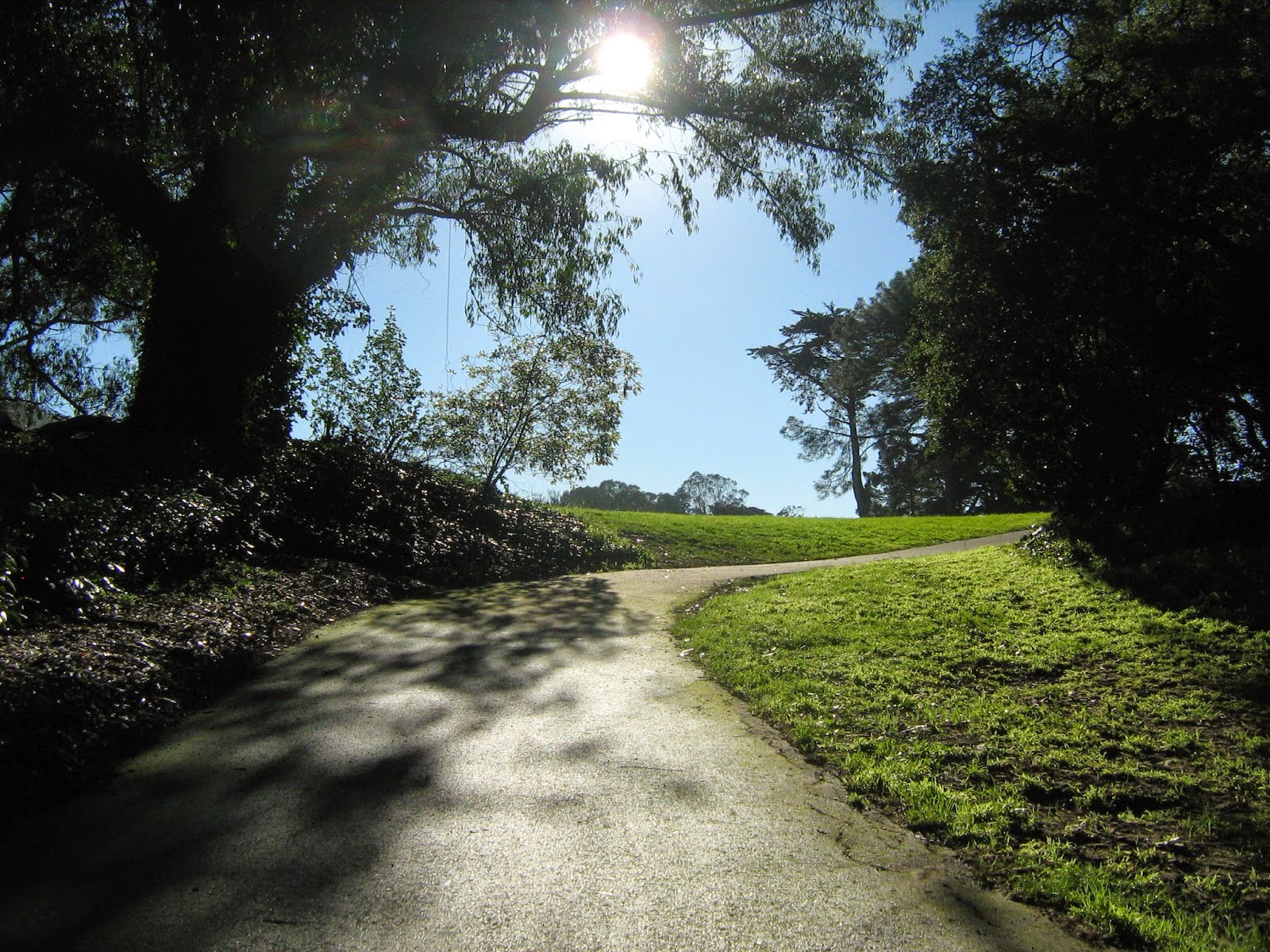

breathed in the glorious expanse at the ridge,


continued west through the AIDS Memorial Grove,


under the tunnels near the Academy of Sciences,


then along JFK Drive, 
on which I passed
a waterfall, 


Lloyd Lake,


and Spreckles Lake, where 
a seagull stood in repose while 


a duck paddled through the water, 
leaving a V in its wake.


Sunset neared as I closed on the ocean, trying to
keep up with the trails of sunlight which 
refracted through tree cover, 
moving west just ahead of me.


The Pacific was, 
as ever, 
Grand.


The big ball in the sky hovered, 
its death glow growing brighter, 


casting orange as it dropped low to the water.


Going,


going,


gone.


Other Truth and Beauty photo essays:

"It Starts with your Heart and Radiates Out" includes San Francisco 
street art, architecture, and miscellaneous city scenes 
in a stroll from the Mission to South of Market to downtown

"Gone but not Forgotten" is a tribute to a friend who left this world all too soon 

"A Sunny* Monday in San Francisco" is a day tour of the city, 
from Mission Street to the Pacific Ocean

"On a clear day you can see forever" explores Noe Valley, Ashbury Heights, 
the Inner Sunset district, microclimates, and street art on a pristine September day 

"Random San Francisco" has 46 photos which range from 
ornate architecture to vistas to murals to sidewalk messaging

"California in November" captures deep fall natural splendor

Tuesday, December 23, 2014

San Francisco sunset, 12/23/14


[Click on photo to enlarge]

Truth and Beauty photo essays:

eye-catching architecture, and miscellaneous city scenes 
in a stroll from the Mission to South of Market to downtown

"Gone but not Forgotten" is a tribute to a friend who left this world all too soon 

"A Sunny* Monday in San Francisco" is a day tour of the city, 
from Mission Street to the Pacific Ocean

"On a clear day you can see forever" explores Noe Valley, Ashbury Heights, 
the Inner Sunset district, microclimates, and street art on a pristine September day 

"Random San Francisco" has 46 photos which range from 
ornate architecture to vistas to murals to sidewalk messaging

"California in November" captures deep fall natural splendor


Friday, December 19, 2014

The Emotion Thesaurus

I'm in the show, don't tell school of fiction writing. 

For better or worse, depending on the sensibility of the reader, I include a fair amount of description in my fiction. This is both conscious (a desire to mold round, sympathetic characters in vivid physical landscapes) and unconscious (a reflection of my sometimes fine-grained sense of detail, a carryover from the observational journal writing I did in my teens and twenties).

In the process of editing my novel, I inevitably find characters repeatedly doing some of the same things—walking, sitting, standing, smiling, listening, looking—and experiencing a common subset of emotions (happiness, sadness, excitement, worry).   

To challenge myself as a writer and keep the experience fresh for the reader, I strive to change the words and phrases describing these actions and states as much as possible. And I generally prefer to communicate emotions through non-verbal cues and body language rather than directly tell (telegraph) what a character is feeling inside, though I make exceptions for more stoic or introverted characters.

Roget's Super Thesaurus and thesaurus.com have helped me dig out individual words for simple actions, but single words are rarely enough to convey characters' emotions. The Emotion Thesaurus: A Writer's Guide to Character Expression, which includes 75 emotional states—such as amazement, curiosity, love, desire, depression, and nostalgia—goes much further. 

Each state has a two-page entry which begins with a definition and follows with five sub-categories: physical signals, internal sensations, mental responses, and cues of both acute/long-term and suppressed emotion.

The first entry, adoration, is defined as "the act of worship; to view as divine." 

Thirty-two physical signals are listed next, including "becoming unaware of one's environment or other people" and "keeping trinkets, pictures, or articles of the subject."

Internal sensations and mental responses follow. Gratitude's internal sensations include "a release of all bodily tension" and a "heart that feels full"; among gratitude's mental responses is "desiring to repay another's kindness and support."

After sensations come cues. One cue of acute or long-term adoration is "a sense of destiny (of belonging together)." Cues of suppressed adoration include "watching or observing from afar" and "creating chance run-ins." Branching off of the cues of acute emotion is a section
entitled "MAY ESCALATE TO," e.g. adoration "MAY ESCALATE TO LOVE, DESIRE, FRUSTRATION, HURT."

Each entry ends with a writer's tip. The tip for regret mirrors the main purpose of this book:  "Watch for possible description crutches. Is the color 'green' used too much? Does a sensory sound (like wind rustling through the trees) happen in multiple scenes? Keep track of these details to avoid overuse." 

If you know a creative writer who wants to expand their horizons—and their craft—consider gifting The Emotion Thesaurus this holiday season.

                                     More pieces about writing on Truth and Beauty: 


Saturday, December 13, 2014

Justice delayed: "Kill the Messenger" vindicates Gary Webb

“Kill The Messenger” is a movie about high-stakes, shoe leather journalism.

In July of 1995, Gary Webb (Jeremy Renner)—a Pulitzer prize-winning investigative reporter for the San Jose Mercury News—received a tip from Coral Baca, the girlfriend of Rafael Cornejo, who was being charged in a federal narcotics case.

During the San Diego trial, Webb discovered that Danilo Blandón (a Nicaraguan citizen and DEA informant who was testifying against Cornejo) had been involved in the sale of up to $6 million worth of cocaine per week to Ricky Ross—a major dealer in Compton during the ’80s. Some portion of the proceeds had been used to support the Contras, a CIA proxy army which had attempted to overthrow the leftist Sandinista government in Nicaragua.

Under cross-examination Blandón admitted that members of the CIA were aware that he was dealing drugs, launching Webb on a life-altering journey.

“Kill the Messenger,” based on a true story, moves with Webb as he follows this initial lead through the mean streets of Compton, a remote airstrip in Honduras, a dingy prison in Nicaragua, and miles of microfiche. This journey is sprinkled with depth of field shots (of potentially sinister people following Webb) and shaky camera footage which amplifies dicey situations, but generally the visual language is subtle and understated, as one would expect of a $5 million movie. “Kill the Messenger” is a small movie about big things.

Webb’s year of extensive traveling and dogged research was channeled into the "Dark Alliance" articles, 
The logo for the "Dark Alliance" series
which sent the CIA's P.R. outfit into high gear  
which were published in print and online in August of 1996 by the San Jose Mercury News.

The three-day series not only pointed out that officials in the CIA and the Reagan Administration had looked the other way while members of the Contras sold cocaine in the U.S., but claimed that the Blandón-Ross connection had been the first large-scale drug pipeline of its kind and had played a central role in the crack epidemic which—along with the punitive, racially-biased policies of Reagan’s War on Drugs—had decimated inner city populations.

In the beginning, the explosive allegations were a boon to the Mercury News. “Dark Alliance” was the first blockbuster series of its kind to go around the major media filters—the networks and the big newspapers—through the Internet. To bolster the series’ controversial claims, ample links to the sourcing (audio files, court transcripts, government reports, and other legal documents) were included on the Mercury News website. The story went viral, getting up to 1.3 million hits and generating outrage in the African-American community. Webb was a conquering hero around the newsroom, David slaying Goliath.


Webb taking notes at Rafael Cornejo's hearing
For most of the movie, this is how Renner portrays Webb: as a fearless, earnest truth-seeker who is obsessed with his work. Webb walks through doorways with swagger, aggressively presses his points home when challenged, and packs heat to protect his family.

But Goliath turned out to be a sleeping giant. After overlooking CIA connections to drugs for decades and ignoring the "Dark Alliance" story for several weeks, the Big Three (the New York Times, L.A. Times, and Washington Post), all of whom relied heavily on CIA officials for national security reporting, went after Webb and his series. The L.A. Times, a major daily which had been scooped in its own backyard by a second-tier newspaper, was particularly vicious, putting 
together a hit team of 17 people to comb every word of Webb’s articles in a blatant attempt to discredit the series—and Webb himself. 

In time, even as Webb was strengthening the claims made in his original series with additional research and interviews—evidence which his newspaper never published—the Mercury News’ corporate heads got weak in the knees from pressure exerted by the CIA and its media allies. Webb, who won Journalist of the Year from the Bay Area Society of 
An explosive story idea is pitched in secret
Professional Journalists at the end of 1996, was demoted just months later to a satellite office in Cupertino, 150 miles away from his family. The Mighty Wurlitzer—the ability of the CIA to program the U.S. media like a player piano—remained undeterred.

Broken down, humiliated, and blacklisted in his chosen profession, Gary Webb committed suicide in 2004.

“Kill the Messenger” is effective at conveying these main facts, but the number of important things which are left out reflect the limitations of the biopic genre to tackle complicated historical events.

As shown by the findings of the Iran-Contra investigation, the report of the Senate Subcommittee on Terrorism, Narcotics, and International Operations headed by John Kerry, the CIA Inspector General's report of 1998, and the National Security Archive release of Oliver North's diaries, in 2004, there is no question that dozens of Contras sold drugs in the U.S., that members of the CIA and Reagan Administration knew this and ignored it, and that the Reagan Administration fought to hide this information from the public.

What “Kill the Messenger” doesn’t do is probe the more disputable elements in the “Dark Alliance” series in great depth. How accurate was Webb’s speculation on the precise years of Blandón and Ross’s business relationship and the resulting extrapolation of the amount of cocaine that passed between them? What portion of the sales went to the Contras and what portion went back into Blandón’s pocket? Were these transactions—when coupled with Ross’s eventual countrywide expansion—enough to set off the crack explosion, as the series claimed, or were they just one part of a much bigger phenomena? To what extent did Webb’s book (“Dark Alliance: The CIA, the Contras, and the Crack Cocaine Explosion”), which

included much more expansive sourcing than the original newspaper story, clear up these questions?

And Renner’s characterization focuses on Gary Webb the alpha journalist to the exclusion of other dimensions of Webb’s personality. The two times I saw Webb speak at Bay Area journalism events, I witnessed a relaxed demeanor and a sharp sense of humor (often mentioned by family and friends) which are mainly absent in the movie. Webb’s bi-polarity, the struggles with depression which led him to take his own life, also get short shrift.

Despite these gaps in the storyline, Jeremy Renner and the other principals behind “Kill the Messenger” deserve a public service award for bringing this project to fruition. “Kill the Messenger” is a substantial movie which honors an exceptionally brave journalist who put his livelihood on the line for the public’s right to know.

Toward the end of the movie, as Webb sits in a ballroom about to receive an award, he hears his name announced. He imagines a standing ovation, only to mount the podium to scattered applause. In a just world, “Kill the Messenger” would be playing in Multiplexes, waking the sleepwalking masses up to hidden histories in their midst.

As it is, Renner’s labor of love won’t get a fraction of the attention—from the media or the Academy—that have attended other movies about momentous journalism such as “All the President’s Men.” Eighteen years after it was published, the revelations of the “Dark Alliance” series have been completely swept under the rug. While the Woodward-Bernstein takedown of President Nixon was said to prove that “the system works,” the tepid reception of “Kill the Messenger” shows that in the case of the Contra-crack-cocaine story, the system failed.


***
           
GARY WEBB’S JOURNALISTIC AWARDS (courtesy of Wikipedia)

College journalism:

  • 1975 — First place, specialty column, Kentucky Intercollegiate Press Assn.
  • 1977 — Third place, specialty column, Kentucky Intercollegiate Press Assn.
  • 1977 — Third place, non-editorial cartooning, Kentucky Intercollegiate Press Assn.

Reporting:

  • 1980 — Investigative Reporters and Editors (IRE) Award, small newspaper division.
  • 1980 — Laurel, Columbia Journalism Review.
  • 1980 — Gerald M. White Memorial Prize for Investigative Reporting, Cincinnati SDX.
  • 1980 — Investigative Reporters and Editors Award (IRE) for co-authoring a 17-part series at the Kentucky Post in Covington, Kentucky with Tom Scheffey on organized crime in the American coal industry. 
  • 1981 — First place, investigative reporting, Kentucky Press Assn.
  • 1981 — Second place, deadline news reporting, Cincinnati SDX.
  • 1981 — Third place, investigative reporting, Cincinnati SDX.
  • 1982 — Third place, investigative reporting, Kentucky Press Assn.
  • 1983 — First place, municipal reporting, Kentucky Municipal League.
  • 1983 — Reporter of the Month, Scripps Howard Newspapers.
  • 1984 — Second place, series, Ohio Associated Press Assn.
  • 1984 — Third place, series, Ohio Associated Press Assn.
  • 1985 — Laurel, Columbia Journalism Review.
  • 1985 — First place, investigative reporting, Northeast Ohio SDX.
  • 1986 — Honorable mention, enterprise reporting, Ohio Associated Press Assn.
  • 1986 — Honorable mention, series, Ohio Associated Press Assn.
  • 1986 — First place, investigative reporting, Northeast Ohio SDX.
  • 1986 — Gold Medal, health reporting, American Chiropractic Assn.
  • 1987 — First place, legal reporting, Ohio Bar Assn.
  • 1987 — Second place, spot news, Central Ohio SDX.
  • 1987 — Third place, projects, Central Ohio SDX.
  • 1987 — Honorable mention, features, Central Ohio SDX.
  • 1987 — Freedom of Information Award, Central Ohio SDX.
  • 1987 — First place, investigative reporting, Ohio Associated Press Assn.
  • 1988 — First place, investigative reporting, Ohio Associated Press Assn.
  • 1989 — Honorable mention, features, Central Ohio SDX.  
    The scoop that would
    change Webb's life
  • 1989 — First place, series, Central Ohio SDX.
  • 1990 — Pulitzer Prize for General News Reporting awarded to the San Jose Mercury News staff for its detailed coverage of the October 17, 1989, Bay Area earthquake and its aftermath.
  • 1993 — Second place, series, Peninsula Press Club.
  • 1994 — H.L. Mencken Award, by The Free Press Association for the series in the San Jose Mercury News on abuses in the state of California's drug asset forfeiture program.
  • 1995—California Journalism Award, Center for California Studies, CSU.
  • 1995 — Honorable mention, Gerald Loeb Award, UCLA School of Business.
  • 1995 — First Place, local news reporting, Peninsula Press Club.
  • 1996 - James Aronson Award for Social Justice Journalism, Hunter College, City University of New York.
  • 1996 — Freedom Fighter Award, California NAACP.
  • 1996 — Journalist of the Year, Bay Area Society of Professional Journalists.
  • 1997 — Media Hero Award, from the 2nd Annual Media & Democracy Congress.

Literary:

  • 1998 — Firecracker Alternative Book (FAB) Award, politics, Dark Alliance.
    Webb with some of his "Dark Alliance" research
  • 1998 — Nominee, Best Nonfiction Book, Bay Area Book Reviewers Association, Dark Alliance.
  • 1998 — Finalist, PEN/Newman's Own First Amendment Award, Dark Alliance.
  • 1999 — Oakland PEN First Amendment Award, Dark Alliance.
  • 2002 — 25 Books to Remember, New York Public Library, Into the Buzzsaw (contributor)
  • 2003 — Rouse Award for Press Criticism, National Press Club, Into the Buzzsaw (contributor)